Showing posts with label light. Show all posts

Sunday, January 18, 2026

Light in Darkness


Matthew 2:13-23

This weekend some of us were on a confirmation retreat. We talked about theology – which is just a fancy word for asking, What is going on here? Or, in LNPC speak, Who is this God and what is God up to? And, What is a good life and how do we live it?


But these questions are not just hypothetical and theoretical. They come out of real situations where life is turned upside down, that make asking them a pressing need. All throughout scripture and church history, we read, an extraordinary experience would happen that would shake things up so much that just going on as usual would not work anymore.

In these moments the people who seek to point their lives toward God, and goodness, and hope, come together and ask, what is going on here? How do we make sense of this? Where is God in this and how should we live as a result? 

Specifically, on our retreat we named some of things that send us seeking, like uncertainty, suffering, fear, helplessness and injustice, and these words too are not just hypothetical or theoretical, because another word for injustice is when your best friend can’t come to school for fear for his safety, but you still can go anywhere you want.


A wise person said to me this week, “There are two sides to the Christmas story. One, the coming of the light and two, embracing the dark, for God’s presence is there also.” We like to tell the Christmas story in the coming of the light way. But the story itself has the darkness part too, and that too must be embraced if we are looking for the presence of God.


After Jesus was born, Mary and Joseph stayed on in Bethlehem. They settled in to make a life and raise this child among extended family and neighbors they’d come to know, near the shepherds who must’ve been like a collection of uncles to Jesus by now, not too far from Aunt Elizabeth, Uncle Zechariah and baby John, learning to talk and walk to walk together, perhaps. Life might have just begun to feel a little normal, (whatever that is when you’re raising the Messiah), when the bubble is popped by majestic and exotic visitors from afar descending into their town. 

They give Mary and Joseph gifts, not only gold, frankincense and myrrh, but also their far away and deeper insight that God has come for the whole world, and everyone in it belongs to this story and this story belongs to everyone in it, by embodying their own story of God telling them what God is up to and how they’re shaping their lives around it.  And then together, they’re all doing theology – asking now what? How do we make sense of all this now?


Eventually they say their affectionate goodbyes and the Magi are on their way, when an angel messenger invades Joseph’s dreams again, like happened three years ago when he was told not to be afraid to take Mary as his wife, and says, Right now, take your family to Egypt. It’s not safe here, Go!

And from one moment to the next this little family goes from being settled to unsettled, certain to uncertain, from hosting strangers from a foreign land to being strangers in a foreign land. 


This time they’re not going to a home town of Joseph’s ancestors where they have friends and relatives like they did when they moved to Bethlehem, they’re going to the far reaches of the vast Roman Empire where they know nobody, and don’t share the same customs or even speak the same language.  From a life comfortable and familiar they are thrust into to absolute uprootedness. 


But, when they arrive, people there take them in and give them safety and welcome, hospitality and care. Why? Because strangers are really siblings in the human family, because we all belong to God and each other. And this truth must become deeply embedded and embodied in the human life of our Lord and savior in order for it to mean anything in our own human lives. Jesus is right here when we are with and for one another. 

(By the way, it doesn’t even settle down when the ego-maniac leader dies. The holy family returns to Bethlehem but Herod’s son is in charge there and so it’s still not safe, and only then, when Jesus is like a first-grader, do they finally go back to Nazareth, where their ordinary lives were first interrupted by God’s declaration of coming in to share this life with us all). 


Meanwhile, many families did not escape the violence and horror brought down upon Bethlehem because of Herod’s fragile ego and fear of losing his power. Darkness is real. Evil is evil, and we participate. Human beings are capable of great cruelty and brutality. Human beings are capable of profound compassion and courage.  Both are true, and it is in the darkness that we discover so. 

We can’t depend on the greatness of human beings to save us.  We are cruel and kind, brave and cowardly, right-intentioned and off base, all of us. Let’s be honest, we haven’t the stamina or attention spans to be the source of real transformation, not to mention our terrible tendency to turn each other into enemies and vent our sorrow and anger at evil in one another’s faces and to one another’s destruction. If saving the world and each other is up to us, we are doomed.


Almost two weeks ago I was in Assisi, standing on a foggy mountainside learning about St. Francis in the early 1200s, who started out life a spoiled rich kid, but gave up everything he owned to serve his fellow human beings and live close to the earth, because Jesus spoke to him and awakened him to the profound reality that rather than reaching for God and striving for a good life, this whole world is held by God and every person and creature in it is already completely loved by God, and so is meant to be loved and cared for by us. Our lives are not our own, they are for one another. And other people’s lives are not none of our business, we are here to care for each other. And this earth is not to be taken for granted, it is the home God has given us all to share, and brother sun and sister moon and the rabbits and the birds and the people behaving badly and the people in need of help are all ours and we are theirs, and everything and everyone belongs, and this is not hypothetical or theoretical. 


The darkness we are living through right now is real and tangible and can’t be ignored and makes it impossible to keep living as usual.  But we recognize that where there is darkness, the God who comes in is here, Jesus is here, Jesus who came into death to bring us life, and is doing so even right now, inside the real encounters and between regular, human lives. In the middle of despair, uncertainty, fear, suffering, helplessness and injustice, are people embracing each other with compassion and care, hospitality and welcome, experiences that shake us up with hope, and strangers discovering we belong to each other because we’re all really siblings in this human family. 


Evil is real and not to be trifled with. But its strength is in fear, and it can not prevail over love that leaks in and rises up and persists, and one day will be the totality and the fullness of life for all, because love comes from God and returns to God taking everyone and everything into its healing hold. The tastes and glimpses of this we experience now come when we surrender our lives into God’s hands, and we find ourselves praying with St. Francis, “make me an instrument of your peace, where there is hatred let me sow love.” 


I could list examples of this Kingdom of God light in the darkness, but all week long you all have been proclaiming the gospel to me, and any stories of hope or trust I would share today are coming from your lives, and moments in your neighborhoods and schools. 

So it feels like what we need right now is to do some theology together—not hypothetical and theoretical, but simply to ponder with all the saints, What is happening? Where is God in this? And how are our lives being shaped in response? 


So I am going to open up the space for ‘Kingdom of God sightings,’ so we can do the work of the church, and share where we have seen God at work, and where we have participated in the Kingdom of God as it is unfolding among us. 


(We passed the mic and stories included teachers driving kids home who don't have a safe ride, grandparents in traffic vests walking school grounds all day, a church paying the rent of their neighbor’s temporarily closed business, a middle school kid’s story about interpreting the events of the day with each another during a special assembly, seeing someone at a frigid protest give her down mittens to stranger with flimsy gloves, switching around carpools to protect Somali parents, messages of solidarity from other states and countries and across political spectrum, etc.)

Wednesday, December 25, 2024

A Christmas Eve Message in Carols


Isaiah 6:2:6-7, John 1:1-5, Luke 1:26-38, Matthew 1:18-25,
Luke 2:1-20

Christmas songs are the most eclectic collection of music that exists in the same genre. Streaming Christmas music you’ll bounce through tragic break-ups, saucy hook-ups, light-hearted dust-ups, and adorable mix-ups. You’ll go from anthropomorphized snowmen and catty reindeer to ancient magi, alarming angels, and imagined drummer boys. Whiplashing from glee to longing, wistfulness to punchiness, and superficiality to scripture with ho, ho, hos, fa, la, las, and glory-alleluias, the whole thing becomes backdrop soup that we stop really hearing.
 
But it’s also true that some of the most poignant and powerful lyrics ever written are sung at Christmas. Christmas songs can preach!
 
I recently came across all the words of Henry Wadsworth Longfellow’s “I Heard the Bells on Christmas Day.” Bing Crosby croons a few verses but skip others. I did not know it was a Christmas poem written amidst the horrors of the Civil War. 
 
Listen to what Longfellow wrote:
 
I heard the bells on Christmas Day
Their old, familiar carols play, 
And wild and sweet
The words repeat
Of peace on earth, good-will to men!

And thought how, as the day had come,
The belfries of all Christendom 
Had rolled along
The unbroken song
Of peace on earth, good-will to men!

Till ringing, singing on its way,
The world revolved from night to day,
A voice, a chime,
A chant sublime
Of peace on earth, good-will to men!

Then from each black, accursed mouth
The cannon thundered in the South, 
And with the sound
The carols drowned
Of peace on earth, good-will to men!

It was as if an earthquake rent
The hearth-stones of a continent,
And made forlorn
The households born
Of peace on earth, good-will to men!

And in despair I bowed my head;
"There is no peace on earth," I said; 
"For hate is strong,
And mocks the song
Of peace on earth, good-will to men!"

Then pealed the bells more loud and deep:
"God is not dead, nor doth He sleep; 
The Wrong shall fail,
The Right prevail,
With peace on earth, good-will to men."

 
Every year Christmas comes around, interrupting our human stupidity and hatred, whatever current versions of awfulness we are engaged in this year. 
 
Long lay the world in sin and error pining.  
(O Holy Night)
 
Nevertheless, throughout time, when the bells ring Christians gather on this night all over the planet. In the midst of world wars and regional famines, through times of personal loss and communal tragedy, we take up our candles, our silence, and our songs to share again this sacred story, and trust again that the God who comes in will meet us here.
 
No ear may hear His coming, But in this world of sin,
Where meek souls will receive Him still, the dear Christ enters in.   
(O Little Town of Bethlehem) 
 
This is a holy act we do this night.  Because if Christmas has any real and lasting meaning, it can’t just be a bubble bath of nostalgia, or a Netflix binge of escapism. But neither can it be positive platitudes or religious head-patting. 
 
Life isn’t messing around. We have 15-year-olds with guns and countries invading each on a dying planet. Right this moment in the very place our little Lord Jesus lay asleep on the hay, people are suffering and dying, their homes and lives destroyed. And in-between our holiday shopping and wrapping, people are logging online to cheer for a murderer,  because we’ve stopped seeing the human in one another, and in the world’s richest country people can’t get the healthcare they need. And millions of our siblings live in poverty because we also happen to live in the country with the greatest wealth inequality. We’re not crushing it, you guys.  
We’re angry and lonely, anxious and scared, hurried and stressed, sad and mean. And in an unstable global environment armed with nuclear weapons and massive egos, the future is unknown. 
 
So, if the best of what Christmas has to offer is the warm winter wonderland of fuzzy appreciation for family and friends, and a once-a-year emphasis on kindness, it’s not going to cut it.
 
For hate is strong, And mocks the song
Of peace on earth, good-will to men!
   
 (I Heard the Bells on Christmas Day)
 
So, also, it seems if we’re clinging to the delusion that we humans are somehow capable of righting this ship, we are not. Let’s admit it right now. We are not capable of restoring our wrongs. This world is broken, and we cannot fix it. We are hopeless. It is impossible. 
 
But nothing is impossible for God.
 
And you, beneath life’s crushing load, whose forms are bending low,
who toil along the climbing way with painful steps and slow,
look now, for glad and golden hours come swiftly on the wing:
O, rest beside the weary road, and hear the angels sing.   
(It Came Upon a Midnight Clear)
 
And now, something must happen that we cannot make happen. Something uncontrollable, transformative, and undeserved must break in and change things. It must be both cosmic and personal, universal and particular. We must be met here and now, by something entirely outside of ourselves that embraces our whole selves and everyone else too. We must be found. 
 
The hopes and fears of all the years are met in thee to-night.   
 
(O Little Town of Bethlehem)
 
And so, a voice from the heavens announces to us – to each of us and to all of us ever –FEAR NOT!  
 
 Word of the Father, now in flesh appearing!   
(O Come, All Ye Faithful)
 
Eternity breaks into time! God comes into this life – not as a mighty force overthrowing evil, as much as we may wish that were so, but as a helpless, displaced child into the arms and care of unprepared people in a broken world. 
 
Once in royal David's city stood a lowly cattle shed,
Where a mother laid her baby in a manger for his bed.
 
 (Once in David’s Royal City)
Mild he lays his glory by, born that we no more may die,
born to raise us from the earth, born to give us second birth.  
(Hark, the Herald Angels Sing)
 
God comes into this life, this darkness, this impossibility, the one we are living in right now. This, here, is what is being redeemed by love, flooded with the light no darkness can extinguish. 
 
Light and life to all he brings, risen with healing in his wings!   
(Hark, the Herald Angels Sing)
 
What we are incapable of achieving on our own, the life of wholeness and connection, belonging to God and all others, is given us in Christ. This world, and everyone in it, is claimed for redemption.
 
For lo, the days are hastening on by prophets seen of old,
when with the ever-circling years shall come the time foretold 
when peace shall over all the earth its ancient splendors fling, 
and the whole world give back the song which now the angels sing. 
(It Came Upon a Midnight Clear)
 
 History on its inevitable course is interrupted and rerouted by Jesus’ life, death and resurrection. The whole trajectory now points toward love that will never end.  
 
A thrill of hope the weary soul rejoices, For yonder breaks a new and glorious morn! 
(O, Holy Night)
 
We are not on this spinning ball alone fending for ourselves. The destruction we’ve done and keep doing is not our end. Death, in all its terrifying separation, is not the final word. God has come. There is now nowhere Christ is not actively bringing salvation. The middle of the story is messy, but conclusion has already been written. The world is God’s! The end is love!
 
Then pealed the bells more loud and deep:
"God is not dead, nor doth He sleep; 
The Wrong shall fail, the Right prevail,
With peace on earth, good-will to men."

 (I Heard the Bells on Christmas Day)
 
Christmas calls us to walk alongside each other in impossibility, to watch for God’s in-breaking. This is God’s world, and every one of us has a particular place. We will see Christ when we welcome each exquisite human being here beside us with reverent care. When we tend the complex, fascinating earth with humble wonder. When we join in God’s ongoing creativity, merciful justice, unwavering forgiveness, and potent healing, by accepting all the small moments of connection as invitations into miracle, given by God’s Spirit in our ordinary days. 
 
So God imparts to human hearts the blessings of His Heaven. 
(O Little Town of Bethlehem) 
 
We are loved by God, always and no matter what, here briefly to love one another.  We can’t control most of what happens around us, or even to us, but we can receive our ‘one, wild precious life’ in with the defiant delight of joy. We can live in trust, gratitude, and anticipation for what God will do next.
 
Let earth receive her king; let every heart prepare him room.  
(Joy to the World!)
 
Christmas not a happy distraction from the pain and suffering of life and the darkness and brokenness of this world, it’s the main event. God comes into the brokenness, and through the life, death, and resurrection of God-with-us that begins right here, the world will never be the same. 
Sweet hymns of joy in grateful chorus raise we,
Let all within us praise His holy name!     
 
(O,Holy Night)
 
What we do this night is a holy act. With our glory-alleluia good news songs of great joy for all people, we take up our candles and our calling, to share again this sacred story, so that with confidence and hope, we may go out from this place into the darkness of this night, trusting that the God of light who comes in is indeed redeeming this world, and even now has met us here.
 
Amen.

Sunday, January 15, 2023

Ordinary Miracles and Ongoing Epiphany


Adoration of the Magi, Andrea Mantegna, c. 1495-1505.

When Epiphany dawns, the swaddling clothes have long been packed away in the attic of the peaceful little home, with room for a workshop that Joseph had rented them in Bethlehem, not too far from THE stable, actually, but near enough to town that he got a little business, enough to keep food on the table. 

And to be honest, since the night when the shepherds and angels and everyone showed up in a wild blur of glory and honor, life has been kind of quiet. Mary and Joseph are far from the people and place they’d call home, no grandparents pitching in or aunties around offering advice through Jesus’ first fever, first tooth, first words, first steps. Leaning on their new community for connection and support.  This was not how they imagined their family life would start- not even once they rearranged their imaginings to include God-incarnate crawling across the living room floor.  Other than that one time Aunt Elizabeth and Uncle Zechariah came to visit, commiserating over sleepless nights and nursing woes while the babies gurgled together on a blanket on the floor, it has mostly been just the three of them, mama, dada and Jesus, getting to know each other, gently becoming a family.  Week to week, season to season, it’s an ordinary life. 


Until the pagans show up and call their kid the king of the Jews.  


Just when the story begins to lose its hard edges, when the nostalgia starts to descend and the lens begins to soften, when this baby has begun to feel like he is theirs, a reminder that he is not arrives in the form of sages from a far-off land, astrologers, scientist mystic-scholars who had been watching the skies for signs of God.  

Surprising, perhaps, that those with no personal stake in the story generational anticipation of a Messiah, or claim to Yahweh’s promises to the people claimed by Yahweh, are the ones Yahweh involves next. Their arrival bursts the domestic bubble and exposes the light to all the world.  


Epiphany, we call this day. Enlightenment. Aha!  When the scene is illuminated what was familiar and known one second look completely other and utterly amazing the next, often because you suddenly see things with a broader perspective, or through the eyes of another. 

The Christmas moment speaks God WITH US, Epiphany says GOD with us.  


Attention! Sweet and cuddly though he is, folks, this isn’t your own private Messiah.  He belongs to the whole earth! And all who live upon it belong to this little one who has settled himself contentedly here in your lap.  You are recipients of this miracle as much as the next person, of course, but with just as little sense of what it all means as the rest of us, maybe even less, actually, than these astonishing strangers who have arrived on your doorstep seem to grasp.


After this great entourage of exotic travelers that have flooded this quiet, provincial town exchange greetings with his parents and bestow their gifts on the child (and there were certainly many of them, of course; what a silly modern assumption that there were just three, because one gift a piece), after the camels have been tended to and bedded down, the tents erected and the strangers washed up and unpacked, I love the crazy, cozy image of lamps lit, table set, Mary and Joseph and their surprise visitors all crowded around an unexpected potluck of fragrant dishes. Wall to wall humans, who look different and smell different and wear different clothing and speak different languages, and whose paths never, ever should have crossed on this planet in any conceivable way, breaking bread together, drinking wine together, sharing together what used to be mostly their own private secret that nobody else could relate to. Perhaps tomorrow they’ll invite the shepherds back over for breakfast.


These travelers, who have journeyed over desert and mountains, through seasons and struggles, countless freezing nights and endless scortching day, driven by a quest through unknown to arrive at the very source. And then, from the moment they lay eyes on the child, and Mary and Joseph lay eyes on them, the cosmic cat is out of the bag, so to speak.


The ego-maniacal King Herod is now chomping at the bit to stamp out this newly discovered threat to his power, and the news is out, things are not business as usual; God has really come, the world is topsy-turvy and strangers from a strange land are visiting that nice couple down the street, normal as you please.  And it’s as though that one lone star now shatters into a trillion pieces, filling the sky with bright mess, scattering shards of radiance from one end of the globe to the other.


Of course they stayed a while, these unexpected guests.  After all, it took many months, maybe years, to get there, they’re not just spending one night and leaving.  So what was it like, adjusting to being next to the miracle for a while?  Was it all the more miraculous for its ordinariness? 


How did it feel to go from a distant star and a lifelong, theoretical quest for truth to a flesh and blood child who threw bawling toddler tantrums when he needed a nap, smeared hummus on the dog, and belly-laughed when daddy tickled him with his beard?  

Because here’s a truth, miracles are almost never as sexy in person as they’re built up to be.  


What was it like for Mary and the strangers from the East to fall into some daily patterns together, to have almost nothing humanly in common and yet get one another at a cellular level, sharing in a reality nobody else on earth yet sees, representing to each other by their presence that this really is real. God has really come; the world is being redeemed.  This wonky little collection of folk are now church, if church means, and I think it does, the people gathered around Jesus wondering together who God is, and watching together what ,God is up to. But also, maybe, getting annoyed because they load the dishwasher wrong and forget to take their shoes off in the house?


And then after the long visit, and the dreamt warning not to go back to Herod, and the Magi bypassing Jerusalem to return home by another road - (Oh, wasn’t Herod steaming mad when then never swung back by the palace! Didn’t he pace on his balcony with his eyes on the horizon day after day, the realization slowing dawning after one week, two, three, that they were NOT coming back, and there wasn’t a darn thing he could do about it!) - Just after the hugs and blessings and goodbyes, the little family turns back inside, sighing, and expecting, perhaps, that life might return to normal: normal is redefined again. 

Epiphany keeps going, you see.  It doesn’t actually let you turn back. 

By its very nature Epiphany’s path is almost always that of another road.


The new road is revealed when, three years after the one who told him not to be afraid to take Mary as his wife, an angel messenger invades Joseph’s dreams, saying, Take the child and his mother and flea, right now, go to Egypt. Get up! NOW.  And it’s your turn, Joseph, to be the strangers from a foreign land.

God-with-us, who was born in a stable is now transient and homeless, and you along with him, foreigners in a foreign land.  


Some traditions hold that the little family settled in Egypt with the Ishmaelites, that they were received warmly by the way other side of the family tree, way back before Egypt became the land of captivity, the place from which Yahweh delivered the Israelites from slavery, back from the time when it was all the same trunk, the roots, the beginning. Father Abraham - father of us all, descendants as numerous as the stars.


It’s like baby God is on a sightseeing tour of the greatest hits. 

I have been at this project for quite some time, you see…


So to the land of Egypt they went, (part of the Roman Empire at the time), seeking safety and welcome in the hospitality, hearts and homes of strangers, who are all part of the whole great story anyway, while back home among the children of Israel, the so-called “King of the Jews” Herod’s terrible wrath and fear ordered the deaths of all male children under two in an effort to stamp out the light of the world before the flame caught and spread.


Then it was fulfilled what had been spoken through the prophet Jeremiah: ‘A voice was heard in Ramah, wailing and loud lamentation, Rachel weeping for her children; she refused to be consoled, because they are no more.’


And I hate that part of the story and will never understand it, and don’t have a whole lot to say about it, except to notice both that God’s love doesn’t keep madness from happening but suffers it with us, coming as a homeless, transient peasant child, whose identity is revealed to nameless sheep-herders and pagan foreigners and NOT to the powers that be, no matter how loudly they rattle their sabers and fiercely they demand to be in on the secret, and also that as sweeping and awful as Herod’s act of terrible evil was, it seemed not to make a dent whatsoever in the God-with-us project. And while Herod himself is long dead and gone, love endures forever, profoundly and mightily, and every single day God-with-us is with us, transforming our shared life, bringing belonging and hope, redemptive kindness and healing care, and continuing to break through the darkness with light, every moment of every day.


After Herod’s death the little family finally journeys to Galilee, where they settle down at home amid grandparents and lifelong neighbors, to raise their first-grader in Nazareth, where he will run through the same streets, swim in the same streams, sit in the same school and participate in the same synagogue they did, in the tiny familiar world that had cradled and shaped them before their lives were ripped open by the light of the world.  


How was little Jesus shaped by those early wanderings, I wonder? 

What did he absorb from the Magi and the Egyptians, from the journeys and the dreams, and then from those who shaped his sense of home?  How did Epiphany bend his path?


And what about those Magi? The journeyers, soul friends and miracle sharers who brought epiphany onto the scene as much as they received it themselves?  What became of their lives after their encounter with the light of the world? How were they drawn into a lifetime of attunement to epiphany?


Epiphany keeps going, friends. The light of the world shimmers in our very own lives. And nobody gets to own this story – this story holds us all. It can’t be domesticated. What God is doing is always bigger, always more, always beyond us, and also right here next to us, in the minutia of our very ordinary lives. It pierces the darkness, the horrors, the loneliness, the wandering. It shares the awkward and unknown, the familiar and the comforting, the strange and the new, the death and the life, drawing us out into worlds we can’t imagine, bringing us home by roads we can’t foresee. 


Today we get star words. They are not magic. But they are a chance to lift our heads and look beyond ourselves with hearts open to however Christ might encounter us, attentive to wherever God might lead us this year. God is with us, transforming the world. 

So, arise, shine, beloved, your light has come. 

Happy Epiphany.


Sunday, January 16, 2022

Remembering What's True


saiah 43:1-2,10-13 and Luke 3:15-17, 21-22

I have had many conversations with folks this week.  And while some of us may be feeling fine and dandy, many of us are discouraged and disheartened, and frankly, exhausted.  Here we are again, with mask mandates and distance learning, fighting the urge to horde things, and our pandemic vocabulary keeps growing: now we know phrases like “supply chain issues” and “rapid lateral flow tests” and the fine point differences between “isolation” and “quarantine.” 

So let me first say again, that “it’s normal to feel sad in sad times.”  And if you’re feeling more tired than usual, that’s no surprise. We have been buffering for nearly two years and our operating systems are slow.  It’s ok to be slow. It’s ok to do less.  This all is a lot to process, and the constant recalibrating is exhausting.
 
For us in the northern hemisphere, Epiphany comes in the darkest time of the year. In the cold and barren landscape of winter, we spend a couple of months turning our faces toward the light of the world that the darkness cannot overcome.  And right we could use some reminders of things we know and trust but sometimes forget.  So this is a good time for some perspective.  A good time to orient ourselves again toward the light.
 
There are two reminders our scriptures give us today that I want us to hear, that I think will help us in this time that feels a bit dark.  I want us to remember who we are. And I want us to remember who God is.
 
Who we are is not up for grabs, it’s already decided. You are mine. God says. I have chosen you and redeemed you and called you by name.  And this fact is sealed on us by our baptism.
We are baptized into Jesus’ death and resurrection – we die his death and are raised into his newness of life.  So that belonging that Jesus has with God, that belonging he has with the world, that is our belonging. And that life that was there at creation and prevails through eternity is our life. 
 
Some of us were baptized as kids, teenagers or adults and some of us were baptized as infants. When we see a little squirming baby baptized, who didn’t choose to be there and sometimes isn’t very happy about it, we are reminded of some things about God’s promises and our own identity.  First, that it is not about what we choose or decide.  Who we are begins with who God says we are.  And God chooses us, and claims us and calls us God’s beloved child who God is delighted in.  God says YES to us –and we will spend a lifetime learning to receive God’s YES. 
 
And when we see an adult come to the font to be baptized, what we are remined of is in this relationship with God who chooses us, we get to say YES back to God’s YES. We get to embrace our own “one wild precious life” and submit to the journey whatever may come. And Jesus’ life of total belonging to God and other people will be what defines our life. 
 
Like Mary before him, and Joseph, and the Shepherds heeding the angels' call, and the Magi setting out on their journey, and every scared and wondering king and nomad and giant-slayer and sea-parter and child-bearer and prophet and journeyer before them, Jesus says Yes to God, and by the divebombing Holy Spirit like a dove and the voice from heaven, God says Yes to Jesus. 
God says YES to us and we say YES to God.

What does it mean to say YES to God? 
It means we say yes to not being in it alone. We say yes to life and light and hope. We say yes to suffering and struggling and living fully. We say Yes to forgiveness and grace and mercy.  We say Yes to being defined by our belonging to God and each other, and not by what we accomplish or contribute or earn or prove. We say yes to what God is doing to love and save the world, and Yes the astonishing truth that God wants to involve us in it.  
No matter what life brings, or where it brings us, the first and final word over you and me is this: You are my beloved child and I am utterly delighted in you!
That is who we are. And I want us to remember that today.
 
The second thing I want us to remember today is who God is.
Listen to who is saying YES to us:
Before me there was no God and there will be no God after me.
I spoke and saved and promised,
There is no one who can undo what I do.
I act and who can reverse it? 

This is the God who made us, and claims us, and redeems us, and calls us. This is who says YES to us. Our NO can never be bigger than God’s YES. No matter how much we flee or forget or fight God, God’s love will never depart from us. 
We will never stop belonging to God.  
 
And this world will never stop belonging to God. 
God’s love is not hindered by supply chains and shortages, God’s redemption is not slowed down by global pandemics or festering conflicts. Natural disasters, human brokenness and societal failures do not stop God’s salvation in any way. No matter how much pain or loss or suffering, no matter how much fighting or forgetting we do as individuals, or whole people’s and nations, the world’s NO can never be bigger than God’s YES. 
All that God does remains. Every act of healing and love, every moment of connection and hope, every transformation and redemption, every righting of wrongs and building up of humanity, each act of justice, each time peace reigns, every moment of joy and triumph of life can’t be broken or lost, destroyed or ended. 
It is into death that Jesus comes to bring life. It is in the darkness that the light shines.
So, we often find that in the midst of suffering and weakness we may even become more aware of our belonging to each other, more attentive of our identity as beloved, more attuned to God’s relentless YES.  
 
“You are my witnesses” God says, “I chose you to know me, and trust me, and watch for me and join me. I chose you to share my YES with the world. 
 
So whatever these next weeks bring us, bring the world, we will keep remembering together who we are and who God is, and reminding each other.  In our tiredness or sadness, we will still keep being witnesses of our own and each other’s belovedness.  And in the unrelenting unknown and the persistent upheaval, we will still keep practicing saying YES to our belonging to God and each other. Like a song always being playing, we will let the Holy Spirit attune us to God’s unwavering YES in the world, in whatever ways it is beckoning us to join in. 
 
REMEMBRANCE OF BAPTISM
(With water trace the invisible sign of the cross permanently on your forehead)

Hear and speak these words of truth over yourself:
I am a Beloved child of God, in whom God delights. 
I am loved and claimed just as I am, for who I am, not for what I do. 
This cannot be earned and it cannot be lost. 
God has spoken this over me and it cannot be undone.
May I begin here, and let whatever work and rest, whatever sadness and joy, whatever flows out from me and back into me, be a response to this love. And may it give me hope. Amen.

Tuesday, June 2, 2020

How the light gets in

Daily Devotion - June 2

I will send a brief message each day (except Mondays)
while we are pausing gathering in person.
- Kara


Today I participated in a clergy march. Led by black pastors, bishops, rabbis and imams, we walked through the streets to where George Floyd was killed.  Five minutes after we started, the hands in the front went up and a great silence spread through the whole crowd. The only sound was our feet, punctuated by noises from beyond - car horns, onlookers, birds.  But amongst the moving crowd, a prayer, no words, just palpable, holy silence. It is hard to even explain what three blocks of masked people walking, completely silent, feels like. The silence was the loudest thing around - it touched those we passed, causing them to fall silent too.


Twice more a wave came through the crowd. Once when everyone fell to their knees as someone up front prayed.  And then before we rose, the Lord's Prayer came through, building in volume, so that by the time it reached us we joined in one great voice saying "...deliver us from evil. For Thine is the Kingdom, and the power and the glory forever, Amen."

This morning a few of us gathered for coffee and support.  The stress and tension are wearing. Nights are hard; mornings are welcome. We are tired and on edge, mostly tired of being on edge.  But also, among us were a new job, a new engagement, a new lease on life after a hospital release, a lost child found, a daycare resuming soon - glimpses of hope and life.

Here are more reports from among us:

Sue's little garden of hope:
This is my little garden of hope, valiantly growing in my parking lot: the only place with enough sun except, maybe, for the bus stop out front!
A quiet night. Scary troops in vehicles moseying by the house. I DO have a visceral reaction to the presence of the National Guard, based on my experience in the 1960's. But their work has been generally calm and measured. But it is still a scary sight.
They are protecting the sacred memorial space at 38th and Chicago, where George died. People gather there around the clock, grieving with one another. The pain and anger take some into the zone far beyond hope, into such deep mourning and frustration over this senseless death that they cannot see a way out.
I choose hope. I am realistic, though. The systemic problems are hundreds of years deep and human nature much deeper. It is hard to trust one another and even harder to trust our institutions. The targeted destruction of the neighborhood services: food, pharmacy, low income housing: has increased the distrust as peaceful protesters feel targeted by outrage over damage they did not do. Many cannot yet chose hope.
But people, from within and without of Minneapolis are donating food, money, time to the clean up. They chose hope.
Many neighborhoods are taking turns guarding the businesses that provide for their needs. They are choosing hope.
Solutions will come gradually. Most will not work, none will reach perfection. But we must still join together and work hopefully toward a more just society. Three steps forward and two steps back, is still one step forward.
Hope is such a fragile thing, like spring peas and tiny carrots. Tiny, unlikely shoots of green life. It must be looked for and nurtured.


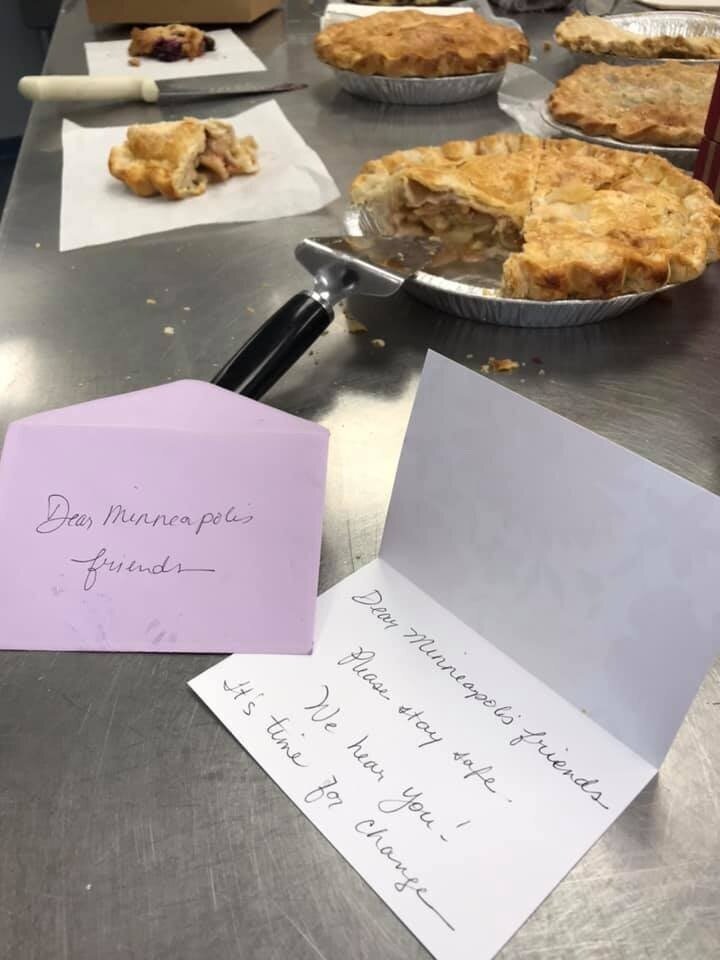
And this message from Lisa's favorite pie shop, Pie and Mighty:
 
IMG_2275.jpg
It might not look like it, but this is Pie & Mighty. Last week, in the wee hours of Saturday morning our front door got kicked in. You don't need us to tell you why.

We've have had an extrordinary start to our little space on Chicago Avenue. We sliced and served our first pies from our new location just 12 weeks ago, on March 14, Pi Day. Ours has been a long journey full of fits and starts and hiccups, but we wouldn't trade one moment away if it all meant we got to be here, now, in this place, at this time. We are so ridiculously grateful.

———————————
One week ago today, just two blocks from where we are, George Floyd was murdered. Ever since then grief has hung in the air like a hot, windless day. It permeates everything, even and especially us. But something magical happened late in the week when Beth Howard, author and pie maker, called us to ask how we were and if we would mind if she came up and gave away free pie? Ummmm, yes please.
As a team we had to dig really deep in ourselves to make the pies we had already committed to and infuse them with our hearts that felt so broken. You know that song by Leonard Cohen called Anthem? That one part that goes like this:
Ring the bells that still can ring
Forget your perfect offering
There is a crack, a crack in everything (there is a crack in everything)
That's how the light gets in
We just had to forget our perfect offerings and let pie do what pie will do. It worked.
On Sunday morning, we sliced and served pie along side of Beth and her team that people made from Donnellson, Iowa to Minneapolis. Over 80 pies and baked goods were made and shared, all in less than 24 hours. Remarkable doesn’t even come close.
It’s Monday. We took today for rest and reflection and discerned that this week we are going to just be together as a team, learning, cleaning, testing, and telling stories. We know this might not seem productive or even helpful to you right now. But thanks for understanding anyway. We’ll be back with our June menu next week.
dearminneapolisfriends.jpg

Each of us is making our way through each day. That is a holy and blessed task. Some of us need rest, others, action. Some of us need to mourn, others to rage, others to let go.  As we watch for the light coming in through the cracks, may worry turn to trust, may tension turn to calm. May we know ourselves and everyone else to be held in the love of God this day, and tomorrow.

CONNECTING RITUAL:
 
Perhaps tonight before bed, whatever time that is in each of our homes, we and so join our souls with each other and the people of the whole earth:

Bless me this night, O God,
and those whom I know and love.
Bless me this night, O God,
and those with whom I am not at peace.
Bless me this night, O God,
and every human family.
Bless us with deep sleep.
Bless us with dreams that will heal our souls.
Bless us with the night's silent messages of eternity
that we may be set free by love.
Bless us in the night, O God,
that we may be set free to love.

Amen.

- J. Philip Newell, Sounds of the Eternal

Sunday, December 25, 2016

The Lord is Come! (Aka, God's non-compliance)


To use this as a take-home service for Christmas Day, follow the red.


I have a stupid tree this year. It looked so great at the lot, the guy held it up and it was glorious and full, the perfect tree. We debated between two, and finally chose this one for being even more perfect than the other one.
But we got it home, and it turns out it doesn’t sit right in the tree stand. It has this thick branch too low down but hacking it off would leave a huge bald spot on the bottom so we left it on. And it was too tall, so we had to saw off the tip of the top with a meat knife and jam the star on the sticky, prickly nubs.  The lights just didn’t go on well; they are clumped in some parts and missing in others, and a few days after its arrival it became the setting of an epic stuffed animal battle so there are bent branches and still the occasional stuffed dog or hamster forgotten deep in the branches. But even if all these things were fixed, it turns out that the trunk itself has a weird bend in it, so it leans dramatically to the side no matter how much time we spend rearranging it, and we’ve spent far too much time rearranging it.

Usually this time of year I love getting up in the early morning and turning on the tree. I will sit by the fireplace, the room lit by the tree’s soft glow, and feel peaceful and hopeful.  This year I wake up and sit with my coffee glaring at this belligerent mess, brazenly slouching against my wall like it’s trying to pick a fight. I wanted to love this tree, even ironically, but I can’t muster anything but irritation for it.  It is not cooperating with my plans.

Apparently I expect Christmas to make me feel cozy, sentimental and serene. But to be honest, I’m not sure Christmas can take the pressure this year. And my tree leans defiantly in my constant sightline as an irksome reminder that things are not quite right.

Today people are going to sit around not quite perfect trees, eating not quite perfect food, opening not quite perfect gifts, having not quite perfect conversations.  And between the joyful moments of laughter and connection, for lots of reasons, lots of people will also be feeling mixed up, anxious, and sad, and then they’ll chide themselves for not being in “the Christmas spirit,” even though the weather isn’t really in the Christmas spirit either.
Christmas is not cooperating with our plans for it.
But guess what? Neither does the first Christmas, actually. 
And neither does God, almost never, in fact.

So let’s step out of a shallow dependence on holiday cheer, and into a different story, one that has very little to do with a jolly version of Christmas contentment -  God’s story of deep darkness pierced by unquenchable light, of expectations thwarted and salvation glimpsed, of love born into in a tense and weary world.

Read Isaiah 9:2-7 
Write on a bit of paper, Where do I want God to come in?  Collect and set aside.


(Read Luke 1:26-38)
We all belong to God, and we all belong to each other. This isn’t trite and shallow: a plea to “just be nice,” or a campaign slogan lying in a muddy puddle under people’s departing feet.
It is the very lifeblood of it all. 

And it looks like this: Mary, Don’t be afraid; You belong to God.  So does the whole world and everyone in it.  Because this is so, God is coming to share life with us, to set us free from everything that tells us otherwise.  And you, Mary, are going to be part of this.  Don’t worry about how it will happen; it will break every rule, because God loves to do impossible things. And because belonging to God means we belong to each other, you wont be alone  - even now, in fact, your impossibly old and undeniably pregnant relative is part of this too.

And then there is Regular Joseph with his regular life, comfortably stretched out before him, predictable and planned, now suddenly shattered.  She is not mine after all, and I am not to be hers. Dear, brokenhearted Joseph, resolving to quietly, in the least harmful way, sever ties, pick up the pieces and start over. 
Don’t be afraid, Joseph. Don’t be afraid to belong to her. God is coming share life with us, to set us free from everything that divides us from God and each other. And you, Joseph, are going to be part of this. God will come as a helpless baby in need of belonging, and you are to love him as your own son.

(Read Luke 2:1-7)
A hugely pregnant Mary and a stressed out, worried Joseph make the trek to Bethlehem, one little, inconsequential family among the masses, traveling under orders of a powerful empire that dominates the people’s lives.  But when God’s celestial army assembles, instead of wiping out the oppressive enemy in the blink of an eye, it forms a giant choir, and belts out God’s persistent, undermining promise of peace on the whole earth to all who belong to God and each other, into the stunned and terrified faces of simple shepherds in a nowhere place. Don’t be afraid, the angels will joyfully holler. You are going to be part of this too! Go and see!

God doesn’t play by the same rules as you and I do. The world wants strength; God comes in weakness. The world values status and power, God chooses the ordinary and unnoticed.  The world praises shiny and slick, God prefers broken and real.  God chose to come in scandal and shame instead of honor and admiration.

Nobody in the Christmas story got to keep their armor. Their illusions about where their strength or purpose or value or identity come from have to die, because really belonging to each other means that all that separates me from God and from others has to die in me. It means all that buries my true self and yours, all that makes me feel like I have to earn my esteem or defend my worth, and all my reliance on things in the world to guarantee me security and stability, that dies.  It all gets taken away to make way for the real. Zechariah, Elizabeth, Mary, Joseph, Shepherds, Magi, all of them get reduced to their simple humanity before they are brought into the Kingdom of God with the words, Now Don’t be afraid!

(Read Luke 2:8-20)
A different story is unfolding, even now, within and through your life, this life, this world. In this reality, everything seems upside down; shepherds become preachers and virgins are mothers, and in a dark and smelly stable, with no doctor or place for them in the inn, the God of the universe lays aside invincibility to be born as a defenseless human baby.
  
The Kingdom of God is here, grown up Jesus will later say, It’s right here. Among us, within us, between us. Hidden and backwards, it comes in weakness, asking us to let go of all that we use to protect ourselves from our most basic humanity and divide us from each other. God’s Kingdom is seen when we step out of our strength and stand with someone else in their brokenness. When we name our own brokenness and need and let someone stand with us. That’s where Jesus already is, already has been, always will be. That’s where we can feel that primal and permanent belonging, to God and to each other, that we were made for and are returning to.
Sometimes we call it love.  And nothing can separate us from the love of God in Christ Jesus. Darkness is real, but Love is the deepest reality and the final word.

(Take out the papers you wrote at the beginning. Read them one at a time, For each one, say, "God is with us in this."  Or, "Into ______ God has come.  Response: God is with us.")

Right into the very mess of it, God comes. 
Into a tense and weary world braced for worse, God comes, thwarting expectations and upsetting plans, threatening power with undermining peace, and piercing the darkness with unquenchable light. 


This is the story you belong to. 
Now, don’t be afraid.

Amen.

Fed and Formed

  Exodus 16:1-15 (16-36) This week I spent three days with a very small group of Christians from around their state. This group is just form...