Showing posts with label fear. Show all posts

Sunday, June 14, 2026

The Same Church, until the world is made whole


 Acts 8:1b-3; 9:1-31

 
I shared with my community a few weeks ago how Andy and I worshiped with the Church in Switzerland and found ourselves at home with these siblings in Body of Christ that transcends all languages, and nations.  A few hours ago, my son worshiped with the Church in Berlin, pastored by a Russian married to an American, where the first encounter he witnessed was the baptism of an Iranian. Right now, my daughter is sharing a meal with the homeless and formerly homeless counselors to suburban, middle-class campers coming this afternoon for a weeklong service learning pilgrimage of poverty, to learn from and serve alongside these leaders whose lives have had suffering and joy right on the surface. On Wednesday, right here our little congregation gathered on the patio and shared a meal, conversation and laughter, and split up into groups who listened to each other’s lives, watching for the movement of the Spirit. And I got to tell a third grader how my “thorn” last month that I was sad and worried about is, this month, my “rose” the very thing I am glad and grateful about, and he bore witness to the work of the Holy Spirit in my life with an eyes-wide, big-grinned, Hooray! This is the view I have in this moment of the Church. 

The story we just read is a further back moment in this ongoing story that is told looking backward, knowing the end before it begins. It is always moving through the upheaval toward the inevitable conclusion formed by God, and directed not by human trajectory or tragedy, but by the ongoing love of Jesus Christ living in and through those who trust in him.  So recognize this incident as a pivotal moment, when Paul—who will go on, unbeknownst to him, to write between a quarter to half of our bible, and whose journeys by sea and horse will spread the gospel throughout the middle East to Europe—gets brought into this Church where we are his siblings.  So, I was excited to get to this text! 

Only, all week long I couldn’t shake thinking about this story in this way: 

Imagine if, during Operation Metro Surge, a community of immigrants was hiding, worrying about what would happen if ICE found them. And then God called one of them by name, and said, Hey, right now, in this house on Hennipen Ave, a man named Greg Bovino has just had a vision of you coming to pray for him and him receiving his sight. I want you to go to him. 

A little bit it makes me sick to my stomach. 

We tell this story as Saul’s ‘conversion,’ and it is. And it is also the story of the community of Christ-followers who were minding their own business and still being persecuted, who were absolutely justified to be fearful of Saul and continually wary and guarded.

And suddenly I can see the harsh and impossible, the divisions, the horror, the brokenness of it all, of us toward one another, and it deflates me. Because from where this story opens, I can’t see a way forward that lets me hold onto my righteous anger or reiterate my boundaries and beliefs. 

On one side this tale begins with Saul as the hero. He is a devout, highly educated Jew with an impressive pedigree who also holds coveted Roman citizenship. He was born in Tarsus (in modern-day Turkey), and moved as a child to Jerusalem, where he studied under a famous and highly respected Rabbi, and became an expert at Hebrew scripture and Jewish law.  He is esteemed, zealous, and deeply committed to upholding the true faith. Saul has gained a name for himself for his relentless efforts to stamp out this heresy called The Way, where instead of worshiping the one true God, misled people are worshipping a criminal who was executed six years ago, Jesus, whom they call the Christ. Saul is on a holy mission to glorify God and defend the faith, and he has all the confidence and conviction to go along with it.

On the other side are the people of God sheltering in place, who had heard of the destruction Saul rained down in Jerusalem and been warned that he had his sights set on them next. These past few years after Pentecost, the Church has grown significantly, but Paul’s rampage in Jerusalem caused Christians to flee the city and scatter. The exact description reads, “Saul was ravaging the church by entering house after house. Dragging off both men and women, he committed them to prison…” Then it goes on to describe the  stoning death of the first Christian martyr, Stephen, which Saul attended, holding the coats of the other heretic-hunters and cheering them on. 

Now this mission he is currently on, to capture all the Christians in Damascus and bring them in chains to Jerusalem, begins with the words, “Meanwhile, Saul, still breathing threats and murder against the disciples of the Lord…”

So here hide these Christians, afraid for their lives. 

And there we are. Stuck between two incompatible stories. Both claiming to worship the God of Israel.  

And then God speaks to one of these cowering Christians. Hey, Ananias.
Yes, God, I’m here and ready.
There is a man called Saul of Tarsus praying in a house a few streets over, and he has seen a vision of you coming to him and praying for him to regain his sight.
God, maybe you haven’t actually heard of this guy, but he is a bad guy, he’s hunting us down, just so you know. He’s already done so much evil in Jerusalem and here he has been given carte blanch to use whatever force he wants against us.  So… want to give a different instruction? I’m all ears.
 And God says Go. I have specifically chosen Saul to be my messenger. I have a plan for him and I will handle him. 
 
This story is astonishing. 

It’s also par for the course for this God. 
For two years we’ve been moving through the bible from start to finish and in no stories are the people the heroes, and nobody remains unchanged. Stereotypes get torn down, the lowly get lifted up, and the ideas people hold of right, or good, or even God, get destroyed and rebuilt. Futures are never what people think they will be because people dream too small and selfish. God goes right to the barriers and the impossibility, breaking chains, and parting seas, and opening wombs, and knocking down giants, and closing the mouths of lions and opening the mouths that could not speak, and out of death and finality bringing life and newness. 

And always, always, God is drawing people deeper, wider, into love, into time, into this world, into relationship with one another, and pushing them outward to the stranger, to the outcast, to the enemy, to the other. God chooses a few admirable people here and there, and many ordinary ones, but also a lot of jerks, cheaters, fools, slow-learners and betrayers. And nowhere are people allowed to hold onto their righteous anger or reiterate their boundaries and beliefs. 
 So here God goes again.
 
I can’t imagine, and the scripture does not tell us, what happens inside Ananias, or between him and this little church in Damascus, what Holy Spirit miracle allows him to go to Saul.  I can imagine the fear when he approaches that house. The pleading for trust in God as his hand reaches for the doorknob.

And I can also imagine, because I have seen this sort of thing for myself, the forgiveness and faith of Jesus Christ moving through him despite him, as he steps inside to minister to this man who came to destroy him, the very embodiment of the threat he most fears. And likewise, Saul, utterly humbled and in need on the other side of the door, must now receive ministry from the people he came to destroy, the very embodiment of the threat he most feared. 
 
When Saul was thrown from his high horse by the blinding light and booming voice from heaven, I wonder if at first he recognized the experience – just like the prophets of old from the deep story of his ancestors, Moses, Elijah, the coherent, thrilling, terrifying moment when transcendence calls by name, only, how horribly discombobulating, then, for it to come not as an affirmation or invitation, but an accusation!  

Saul, Saul, why are you persecuting me?

Who are you Lord?

And the answer shatters everything inside him, I am Jesus, the one you are persecuting!
 
Then suddenly Saul the magnificent is tossed into the wilderness of waiting, the liminal space of loss, confusion, guilt, and unknown, that permeates the story of God’s people again and again, sparing not even Jesus himself. Then, Saul spends three days in darkness without eating or drinking, until, into his tomb, God’s resurrecting love arrives in the form of his enemy standing right here, where he cannot see him and must reach out his hand.
 
 Saul now meets Jesus, in the touch and voice of Ananias, who calls him, against all human odds, ‘Brother Saul” and says, “the Lord Jesus, who appeared to you on your way here, has sent me so that you may regain your sight and be filled with the Holy Spirit.’ And immediately something like scales fell from his eyes, and his sight was restored.” Then, we’re told, “he got up and was baptized” from the death of fear and righteous hatred, into entirely new life in Christ’s own death and resurrection, “and after taking some food, he regained his strength.” 
 
And then Saul is welcomed into the living Body of Christ, who, instead of revenge or retaliation, fear or loathing, shares with Saul healing, nurture, blessing and identity. They give him friendship and begin to reshape his story by telling him the resurrection stories and their own stories. Here among them, the voice who called out to him from the blinding light is given hands and faces, sorrows and names, foibles and families, and Saul gets to know the risen Messiah.  And they too are set free from fear and righteous hatred, by receiving Christ in the person of their enemy. Then, Saul who came to capture the followers of Jesus, instead begins proclaiming in the synagogue that Jesus is the Son of God, and everyone who hears him is confounded and amazed.

A few chapters later, we’re told that the once esteemed and arrogant Saul eventually sheds his strong, famous Hebrew name completely, and goes exclusively by his Roman name, Paul, which means “small.”  

And this part of the story of God ends with the words “The churches in Judea, Galilee, and Samaria were at peace and grew through the power of the Holy Spirit.”
 
And here we are now, this little gathering of that same Church, about to bless some of our own and send them to another little gathering of the same Church, inside just one city of this whole, vast world, filled everywhere with little gatherings of the same Church, that is, people called to surrender our lives into the life of the living Christ, who, through us, by the power of the Holy Spirit, will love without reservation or resentment, heal what is impossibly broken, and forgive and set free without ceasing, until the whole world is made whole.  

And to that I say, Amen!

Sunday, January 18, 2026

Light in Darkness


Matthew 2:13-23

This weekend some of us were on a confirmation retreat. We talked about theology – which is just a fancy word for asking, What is going on here? Or, in LNPC speak, Who is this God and what is God up to? And, What is a good life and how do we live it?


But these questions are not just hypothetical and theoretical. They come out of real situations where life is turned upside down, that make asking them a pressing need. All throughout scripture and church history, we read, an extraordinary experience would happen that would shake things up so much that just going on as usual would not work anymore.

In these moments the people who seek to point their lives toward God, and goodness, and hope, come together and ask, what is going on here? How do we make sense of this? Where is God in this and how should we live as a result? 

Specifically, on our retreat we named some of things that send us seeking, like uncertainty, suffering, fear, helplessness and injustice, and these words too are not just hypothetical or theoretical, because another word for injustice is when your best friend can’t come to school for fear for his safety, but you still can go anywhere you want.


A wise person said to me this week, “There are two sides to the Christmas story. One, the coming of the light and two, embracing the dark, for God’s presence is there also.” We like to tell the Christmas story in the coming of the light way. But the story itself has the darkness part too, and that too must be embraced if we are looking for the presence of God.


After Jesus was born, Mary and Joseph stayed on in Bethlehem. They settled in to make a life and raise this child among extended family and neighbors they’d come to know, near the shepherds who must’ve been like a collection of uncles to Jesus by now, not too far from Aunt Elizabeth, Uncle Zechariah and baby John, learning to talk and walk to walk together, perhaps. Life might have just begun to feel a little normal, (whatever that is when you’re raising the Messiah), when the bubble is popped by majestic and exotic visitors from afar descending into their town. 

They give Mary and Joseph gifts, not only gold, frankincense and myrrh, but also their far away and deeper insight that God has come for the whole world, and everyone in it belongs to this story and this story belongs to everyone in it, by embodying their own story of God telling them what God is up to and how they’re shaping their lives around it.  And then together, they’re all doing theology – asking now what? How do we make sense of all this now?


Eventually they say their affectionate goodbyes and the Magi are on their way, when an angel messenger invades Joseph’s dreams again, like happened three years ago when he was told not to be afraid to take Mary as his wife, and says, Right now, take your family to Egypt. It’s not safe here, Go!

And from one moment to the next this little family goes from being settled to unsettled, certain to uncertain, from hosting strangers from a foreign land to being strangers in a foreign land. 


This time they’re not going to a home town of Joseph’s ancestors where they have friends and relatives like they did when they moved to Bethlehem, they’re going to the far reaches of the vast Roman Empire where they know nobody, and don’t share the same customs or even speak the same language.  From a life comfortable and familiar they are thrust into to absolute uprootedness. 


But, when they arrive, people there take them in and give them safety and welcome, hospitality and care. Why? Because strangers are really siblings in the human family, because we all belong to God and each other. And this truth must become deeply embedded and embodied in the human life of our Lord and savior in order for it to mean anything in our own human lives. Jesus is right here when we are with and for one another. 

(By the way, it doesn’t even settle down when the ego-maniac leader dies. The holy family returns to Bethlehem but Herod’s son is in charge there and so it’s still not safe, and only then, when Jesus is like a first-grader, do they finally go back to Nazareth, where their ordinary lives were first interrupted by God’s declaration of coming in to share this life with us all). 


Meanwhile, many families did not escape the violence and horror brought down upon Bethlehem because of Herod’s fragile ego and fear of losing his power. Darkness is real. Evil is evil, and we participate. Human beings are capable of great cruelty and brutality. Human beings are capable of profound compassion and courage.  Both are true, and it is in the darkness that we discover so. 

We can’t depend on the greatness of human beings to save us.  We are cruel and kind, brave and cowardly, right-intentioned and off base, all of us. Let’s be honest, we haven’t the stamina or attention spans to be the source of real transformation, not to mention our terrible tendency to turn each other into enemies and vent our sorrow and anger at evil in one another’s faces and to one another’s destruction. If saving the world and each other is up to us, we are doomed.


Almost two weeks ago I was in Assisi, standing on a foggy mountainside learning about St. Francis in the early 1200s, who started out life a spoiled rich kid, but gave up everything he owned to serve his fellow human beings and live close to the earth, because Jesus spoke to him and awakened him to the profound reality that rather than reaching for God and striving for a good life, this whole world is held by God and every person and creature in it is already completely loved by God, and so is meant to be loved and cared for by us. Our lives are not our own, they are for one another. And other people’s lives are not none of our business, we are here to care for each other. And this earth is not to be taken for granted, it is the home God has given us all to share, and brother sun and sister moon and the rabbits and the birds and the people behaving badly and the people in need of help are all ours and we are theirs, and everything and everyone belongs, and this is not hypothetical or theoretical. 


The darkness we are living through right now is real and tangible and can’t be ignored and makes it impossible to keep living as usual.  But we recognize that where there is darkness, the God who comes in is here, Jesus is here, Jesus who came into death to bring us life, and is doing so even right now, inside the real encounters and between regular, human lives. In the middle of despair, uncertainty, fear, suffering, helplessness and injustice, are people embracing each other with compassion and care, hospitality and welcome, experiences that shake us up with hope, and strangers discovering we belong to each other because we’re all really siblings in this human family. 


Evil is real and not to be trifled with. But its strength is in fear, and it can not prevail over love that leaks in and rises up and persists, and one day will be the totality and the fullness of life for all, because love comes from God and returns to God taking everyone and everything into its healing hold. The tastes and glimpses of this we experience now come when we surrender our lives into God’s hands, and we find ourselves praying with St. Francis, “make me an instrument of your peace, where there is hatred let me sow love.” 


I could list examples of this Kingdom of God light in the darkness, but all week long you all have been proclaiming the gospel to me, and any stories of hope or trust I would share today are coming from your lives, and moments in your neighborhoods and schools. 

So it feels like what we need right now is to do some theology together—not hypothetical and theoretical, but simply to ponder with all the saints, What is happening? Where is God in this? And how are our lives being shaped in response? 


So I am going to open up the space for ‘Kingdom of God sightings,’ so we can do the work of the church, and share where we have seen God at work, and where we have participated in the Kingdom of God as it is unfolding among us. 


(We passed the mic and stories included teachers driving kids home who don't have a safe ride, grandparents in traffic vests walking school grounds all day, a church paying the rent of their neighbor’s temporarily closed business, a middle school kid’s story about interpreting the events of the day with each another during a special assembly, seeing someone at a frigid protest give her down mittens to stranger with flimsy gloves, switching around carpools to protect Somali parents, messages of solidarity from other states and countries and across political spectrum, etc.)

Sunday, May 4, 2025

Defiant Hope that Doesn't Come From Us


Jeremiah 29, 31

Ezekiel 37:1-14


Some of you will remember the Lent we hid Alleluias and then didn’t find them again for two years. I don’t mean a few of them that got mixed up with the next year’s messages. I mean, we didn’t even look for them.  

The theme that year for Lent was Hope. We wore it on bracelets and hung a banner in our hallway that read:

Fear says “what if…?”

Hope answers, “even if…!”

And then, all of a sudden, a what if worse than our fears gripped the entire world and life as we knew it screeched to a terrible and terrifying halt. And what ifs were suddenly the reality we were living in –What if nobody can go to work or school or restaurants or to church or get haircuts or ? What if all the things everybody has been working on suddenly don’t matter –the school plays and tournaments, final projects and work trips, and community gatherings, the goals and plans just disappear, unfinished? What if tons of people are sick and dying and the threat of sickness and death overshadows everything we do? 

Throughout it all, we gathered on zoom – seeing each other’s face and each other’s pets, sharing show-n-tell videos, and delivering advent bags and making mix cds. We prayed every morning and night with a family while mom was dying of cancer, and even had a masked, open windows retreat following directions from her oncologist, and day after day, week after week, we showed up for each other in a thousand tiny ways we’d never thought of before. And behind our backs, while our Fear and Hope banners hung in the empty hallway, and the hallelujahs stayed hidden in corners and under cushions in the abandoned sanctuary, the basement was buzzing with life, transforming into a space for a school to move in to one day even if. 

Through it all, God met us again and again and again, and we felt the presence of the risen Jesus who came into this life to be with and for us when we were with and for each other. Even though we couldn’t often bephysically with each other, nevertheless God kept taking care of us and helping us take care of each other, and redemption and hope were tangible.  

And then came Good Friday, and we came back together into the darkness to tell poignantly the story of Jesus coming into our death. And on Easter Sunday we celebrated the resurrection and found those two-year-old hidden hallelujahs, and Hope’s Even if never rang truer, because we had lived it. 

Even though we were weary and worn out, our trust and the confidence of our faith was unshakable: the God who made and loved this world is redeeming it. And despite all the suffering and loss and death – and many of our people died in those two years –  we trusted that God is still God, life is for love, redemption is afoot, we participate in joy, and share in healing, and Jesus meets us right here when we come alongside one another in suffering. God is holding the world and moving everything toward wholeness, relentlessly and unceasingly. And God is trustworthy.

In our scriptures today the people of God are still in exile. The feeling of abandonment and hopelessness, ripped from home and all that made up their daily lives, the loss of all the structures that gave them stability as a nation and identity as a people had become their new normal. This desolation has gone on and on, for decades, with no end in sight.  

It is into this hopelessness that the prophets speak the promises of God. Promises of hope for a future. I know the plans I have for you – God says – plans for goodness and not harm. When you seek me, you will find me. I will turn your sadness into joy, your grief into gladness.

Hope isn’t when we feel great about how great things are going and project that they’ll keep being great. That’s optimism and positive thinking. That’s not hope.


Hope comes to us in hopelessness. But hope is also not just uplifting platitudes chucked like water balloons at a house fire. Hope does not deny the suffering and pain of the moment. It begins in what is. It starts in our place of need. Hope is always about wrongs made right, always about redemption and new life, so hope starts in what is broken and dead. 


One of my favorite explanations of hope comes from David Steindl-Rast: “ Some people imagine that hope is the highest degree of optimism, a kind of super-optimism.... A far more accurate picture would be the hope happens when the bottom drops out of pessimism.  We have nowhere to fall but into the ultimate reality of God's motherly caring.
And since patience is as contagious as impatience, it will also be our way of strengthening each other's hope.


In order for hope to awaken in a hopeless people, their imaginations must be awakened for the impossible made possible. It’s one thing for the prophets to say that God brings life out of death. It’s another to show it.  Ezekiel paints the vision of a valley littered with forgotten dried-out bones, the most over and done with, past tense, lifeless of things. Is there anything more bleak than sun-bleached bones scattered in the dust?  As the coroner of Munchkin Land famously said, They’re not only merely dead, they’re really most sincerely dead.  


But then, at the word of God the dry bones clack and rattle together, and bodies form, and finally,  the breath of God—the same breath that hovered over the waters at creation bringing life from utter nothingness, the same breath that breathed life into clay of the newly formed human in the hands of God, the same breath the dead and alive again Jesus will, on resurrection day, breathe on the disciples, when he gives them the Holy Spirit and says receive my peace—this breath arrives on the wind from every direction and fills these reassembled bodies into living, breathing, moving, vibrant newness, remade people, standing and dancing and laughing and walking freely about, as far as the eye could see.


This, the prophet says, is what God does. What God will do.  Wait and Watch.


The prophets awaken our ‘eschatological imagination,’ which means, they invite us to let our vision of a good life be shaped not by what we can see in front of us, but by God’s promised future. Eschatology means the finale of everything, so eschatological imagination means that the coming fullness so fills and animates us that we can live right now into God’s final destiny for humanity. 


Love. Restoration. Forgiveness. Peace. Joy. Connection. Belonging for all. No more sin – which is just a fancy word for being separated from God and each other. God will wipe away every tear and bring wholeness to all that is broken. And when death ends, all that remains is life and love. That’s what’s coming.


A couple days ago I saw an interview with Trey Parker and Matt Stone, the writers of South Park. They said that two important words when writing a good story are ‘because’ and ‘therefore’. A story that of ‘ands’ – and then this happens and then this happens, is just a boring list of events. A good says this happens, therefore this happens, or this happens because this happens. 


The story of life on earth is written with another key word, one we can hear when we live with awakened eschatological imaginations. That word is nevertheless. Every circumstance, experience and situation pulses underneath with this insistent and defiant, nevertheless, moving everything unceasingly toward God’s promised future. 


Nevertheless, even if, despite, anyway, and always. This means that into every single This is not ok comes the prophets’ confident response of hope, so this is not the end. 


So how do we 'get hopeful?' How do we feel hope and trust it? 

Like everything else real and permanent, we can’t force hope to happen to us or make other people feel hopeful. And striving for it will surely wear you out.  "Let the bottom drop out of your pessimism" and fall into the motherly care of God. Dry bones don't make themselves alive.


So maybe the question of those languishing in exile is, instead, how do we cultivate eschatological imagination? How do we live in contagious patience? Can we make ourselves available to the hope that only God can give? 


Last week I talked with several people about how they are living open to hope, who used the words ‘disciplines.’ “The disciplines are sustaining me,” one said. 

This sounds like drudgery, but ‘the disciplines’ are simply the things we do on purpose that practice living in the way of God instead of the way of fear. That is, whether or not we are feeling it, we practice trust and availability to God.  So how are the disciplines sustaining you? Another way of saying this is, how are you praying these days?

One person I know has started praying by baking bread. Surrendering to the patient attentiveness and gentle miracle of mixing ingredients and letting what happens happen– with all the textures and smells and tastes this involves, creating and feeding, connecting to others in the presence this practice demands is something sustaining her and helping her to be available to God’s hope. So, she’s showing up to regularly do it.

Another person told me the discipline of lament is sustaining her. That when yet another story of injustice or horror came across her newsfeed, she felt like wearing all black in mourning. This was a bit out there, so instead she’s begun putting on what she calls her ‘lament bracelets’ – a series of braided black cords on her wrist, her symbolic sackcloth and ashes. She joins the prophets of old in enacting her holy lament. Her dialogue with God reignites every time she catches sight of the bracelets on her wrist, bearing on her body in the world a marker that this is not ok. And so also, this is not the end.

The disciplines don’t have to be the ways of praying that you first think of, or that you’ve always done. Where in your life are you being invited to turn something ordinary into prayer? 

A lifelong non-gardener told me last week that suddenly she is attending to the ground beneath her feet, hands in the soil, turning her back yard into a butterfly sanctuary and discovering that the earth knows the great nevertheless better than we do and will tell us if we listen.

For me, a new discipline has emerged walking the dog in the morning.  It’s the task I often dread, and frequently try to put off, but I can only delay Bertie’s demands until about 7 am before I am begrudgingly out there on the sidewalk wrangling 75 lbs of curious energy through the neighborhood. But after these conversations about the disciplines, I saw the invitation to for this daily chore to become, instead, a discipline, a practice of prayer.

 By walking alongside Bertie day after day, I am attuning her to my presence and my voice, I am teaching my dog to know and trust me, to listen to me, and respond to my commands. Perhaps her need for this with me could meet my need for this with God.  So, I put my phone on do not disturb, and step into the morning air with this dog, to walk alongside God, so the Holy Spirit can attune me to God’s presence and voice, teach me to know and trust God, help me to listen to God and respond to God’s commands.

Talking to God while loading the dishwasher. Singing hymns in the shower. Memorizing a bible verse and reciting it to yourself in the car. Praying blessings on each little person who climbs into your carpool. What ordinary activity or ritual might become for you a discipline?  Or what disciplines might attune you to God’s presence and voice?

Last week I preached at Boulevard Baptist Church in Anderson, South Carolina about blessing. I said blessing something or someone acknowledges their belonging to God and names God’s sovereignty over them. The act of walking around blessing the world and the people in it resists evil and counters fear by refusing to treat the world, or any person in it, as beyond hope. Instead, it places each person or thing squarely back in the arms of God and awaits with anticipation what God will do with it. In other words, blessing is a way of exercising our eschatological imagination, and cultivating a waiting readiness to join in God’s work of healing whenever and however it might arise.  

Living like this is not a solo gig. This is why we are church. We pray for each other, and we pray for the world together.  We tell each other the stories of how God met us and where we saw life come out of death.  We stay rooted in the ancient story of God’s faithfulness to generations gone by, and remember how God sustained us in our own crises gone by.


 We tell each other again and again how God was with us then, and help each other notice what God is doing now.  We recognize struggle as longing for wrongs to be made right, and see despair as the very place where hope is needed, so that’s where we go to await and anticipate hope. Together we stand in the pain and of what is, and practice living from what will be, knowing that the God who arrives will arrive among us again. 


With a patience that is contagious we wait and watch, because always and nevertheless, God is still God, life is for love, redemption is afoot, we can participate in joy and share in healing, and the risen Jesus will meet us right here when we come alongside one another in suffering. Relentlessly and unceasingly, God is holding the world and moving everything toward wholeness. And God is trustworthy.

Amen.

Sunday, April 20, 2025

As for you...


 On Tuesday I sent my son an Easter basket, and inside was an Apple AirTag for his luggage. But how fun, I thought, to activate it now, name it “Owen’s Easter Basket,” and watch it travel across the country all week to him!  

At first this was fun. It’s in Toledo! It’s crossing into Pennsylvania! But then it got bad. On Friday: why is it sitting in that building on the port of New Jersey it was supposed to have arrived?  On Saturday, why is it now at that address? Was it misdelivered? Is someone else eating his Cadbury egg?? 

And then the final hours yesterday afternoon were the worst. I watched Owen’s Easter Basket zigzag and crisscross his neighborhood, circling within a mile from him but bypassing his street again and again. And I couldn’t stop obsessively checking on it. This had become zero fun.

When the basket finally got to him I was exhausted. But I realized tracking that Easter basket was a familiar feeling. Checking in on its progress every three minutes was not unlike how I have been obsessively reading articles, refreshing my newsfeed, following every breaking story however small. Do I think watching it all so closely will change anything? Why do I keep choosing anxiety instead of presence?

I asked people the other night at Church Chat how they were doing, and we had some fun catching up on the various catchings up, but later one person commented on how it’s hard to answer that How are you? question these days when it feels like every minute there’s a new way our country seems to be falling apart or hurting someone, but I’m good I guess, they answered.

It is not easy to be a modern person in a complex world, with a window to it all in our pocket at all times. It’s easy to feel like the challenges of this time are uniquely bad, and of course they feel that way to us because they’re what we see and are experiencing. But in the scope of human history, we are no different than our human siblings. 

We’re all given a life filled with joy and connection and pain and suffering, in these miraculous, resilient bodies that are also really fragile and complicated, inside particular families and communities with their own blessings and curses, subject to whatever befalls the place and time we happened to be born in. All of us encounter evil, behold marvels, face deep struggles, taste delicious joy, and bear acute loneliness, and we do it all within whatever larger forces are at play in the world at the moment.  Life is hard, and death comes for us all. 

But by golly, I am going to keep tabs on it anyway. With all my monitoring of the world, now adding on a cross-country road-tripping Easter basket too, I don’t have the attention span for Easter.  I am too busy, and worried, and busy being worried.


Our Lent theme has been, Be Still and Know I am God

Did you ever play that nerdy grammar game where you emphasize different words in a sentence, and it changes the meaning?

Here is an example:

Let’s EAT, Grandma! Quit working on that puzzle and come to the table! 

LET’S eat, Grandma!  C’mon! Everybody else is already eating except us! 

Let’s eat GRANDMA!  a completely different meaning altogether.

BE still and know I am God – don’t perform stillness, actually just BE, like a baby, the very you-ness of you, unfiltered.

Be STILL and know I am God – quit hurrying, assessing, achieving and maneuvering, stop, and watch what happens next

Be still AND know I am God – don’t just sit there numb and disengaged, let your resistance go and be open to what wants to come out of the stillness 

Be still and KNOW I am God – really trust it, in-your-bones believe it

Be still and know I am God –not you, not anything else around you, not the long arm of the government or the deep voice of your shame, but ME, I am God. 

Be still and know I AM God – not I was God a long time ago in the bible days, or I will be God eventually in heaven after you die, but always right now this is true, in fact it’s my name, AMness; when everything else is trapped in time, I AM and AM and AM

Be still and know I am GOD – not a great idea for you to grasp, a message for you to spread, or a religious concept that needs your defending, but GOD, beyond you and without your say-so, the Divine Source of life and final authority over life and death

And there we have it, Isaiah’s message to the Israelites, living in exile and captivity for decades with no end in sight:

Do you not know this? Have you not heard? Who stretched out the heavens, and filled them with stars? All life comes from me and returns to me and in between, guess who holds all of it? ME. I am GOD. 

The leaders of this age? They’re barely planted in the ground before they’re ripped up by the next storm. But look up to the vastness of the sky - I am the architect of the cosmos.

 Sometimes you say God doesn’t care and God isn’t listening. Haven’t you heard? There is nothing I do not know! When you’re exhausted and afraid, turn to me, wait for me, I give strength to the powerless, you will mount up like an eagle and ride on the wind.

This is GOD we’re talking about. Be still and know it.

This God came into all of it with us. He came weak, and took on our suffering, our pride, our alienation and division, our whole power-hungry sinful structure that sees healing for the sick and freedom for the slaves and good news for the poor as a hostile threat to the order of things. And on Good Friday, we heard the terrible story told so gently and powerfully by so many of you: there is nothing Jesus did not inhabit with and for us—he was taunted and humiliated, he was tortured and executed. 

And when he died, his beloved friends, family and followers were crushed with grief and disillusionment. For all intents and purposes, the world had ended. What more evil and hopelessness for humanity is there than for us to kill our God who came into this life alongside us to save us? There is no turning back from that. Darkness and evil prevailed. Death won. But it wasn’t really over. 

So here we arrive to our destination, Easter morning, to celebrate the resurrection of our Lord.  And it turns out if we shift the emphasis to different parts of story, we’ll hear different things, and all of it is good news. 


Our text begins with the words, “After the sabbath…”

which is to say, right in the midst of the greatest, most terrible drama humanity, the earth, the angels and the cosmos has ever witnessed, while the leaders kept scrambling to keep the power and shape the narrative, the followers of Christ, and as Martin Luther points out Jesus himself in the grave, stopped for the sabbath, the great interruption that puts us back in right relationship to God and each other. They paused it all to be still and know that God is God.  Jesus died, they held vigil, then everyone stopped to rest in the obedience of trusting God.  And then, “as the first day of the week was dawning,” the women returned to the work of grieving the dead. 


There is nothing so great, so important, so essential, that we cannot stop and rest in the obedience of trusting God. There is no evil or horror, no righteous errand, and no pressingly urgent obligation that demands so much of our constant, vigilant attention, that we are unavailable to our Creator, our fellow human beings, or the whispers of our own souls.  Did you create the sky and the ocean?  No you did not. When the flailing and the scrambling kick in, Be still and know I am God.


What about the words of the lightening-clothed angel, who comes down in an earthquake, slides back the enormous, sealed, stone, and takes a jaunty seat, while the military professionals with the boring gig of guarding a dead man, they shake like the earth itself with terror and became like the dead themselves? With a nod at their passed-out bodies the angel says, “But as for YOU, stop being afraid. I suppose you’re looking for Jesus who was killed? Well, he’s not here; he has already risen, just like he said he would. Come see for yourself then go quickly and tell his disciples Jesus will meet them back in Galilee. This is my message for you.” 


The powers that be are afraid. This is always true. In fear they hustle, and scramble, and never stop striving to keep power. Money is god, the weak don’t matter, this is the way of fear and sin, and human history has no shortage of stories where it appears that the wicked prevail, those who say otherwise will be silenced, and the dead do not live again. 

But do you not know? Have you not heard? God who rules the cosmos has broken down, torn open, and shaken apart the very foundations of everything. Death itself is overcome, and things are not what they seem. 


So as for YOU, quit being afraid. As for YOU, return to community and together go to the place where you last saw Jesus – because he will meet you again there. The places where the lost are found, and the least are most, and the wrong people are chosen, and the things that do last, like - love and hope and peace - happen, inexplicably, in weakness, and show up in suffering, and the most vulnerable people are the ones through whom the Spirit of the Most High moves, bringing healing and hope, drawing ordinary people into God’s salvation of the world.  As for You, stop being afraid. Go tell the rest of them to meet Jesus where he is already doing his thing.


And shifting the focus to just after that, how about when the scared and joyful Marys run right into the risen Lord who seems to be intercepting their mission, like he couldn’t wait one more second to see them? Our translation has him saying, “Greetings!” like he is delivering their mail or something, but in scripture, this word most often means, “Rejoice!”  So, Jesus throws out his arms and shouts “Rejoice!” and the women shriek and embrace him and fall at his feet weeping with incredulous joy at this glorious impossibility. Jesus pulls them up and repeats the same message the angel gave them, “Ok, now, don’t be afraid any longer. Go to my brothers and sisters and tell them to go back to living their lives, and there they will see me.”


Right now, we could put the emphasis on any part of the sentence of life.  Things are either bad, or they’re good, because that’s always true. Always we could watch and obsess over every nuance of evil unfolding, and we could be available to our Creator, our fellow human beings, and the whispers of our own souls. Our lives are shaped by what we give our attention to. 

This is an invitation.

Christ has risen. 

The God who holds the cosmos brings new life out of death, love indestructible by hate, and hope born from despair - there nothing humans or evil can do that is greater than what God has done and will keep doing until it is complete.  

So as for us, may we quit being afraid, invite each other along, and go meet Jesus in our real lives, just as they are, in this beloved world, just as it is. 

And from time to time, no matter what else is happening around us, let’s be still and know who is God.


Amen.

Sunday, March 16, 2025

To Hold and Uphold


1 Kings 17:1-16

One unfortunate thing about being human over, say, a bird, or a dog, is that humans tend to forget whose we are and who we are. The prophet’s job is to remind us. They create a kind of the hammock of trust suspended between recalling God’s faithfulness in the past, and premembering the future God is bringing. The is essential, because there is nothing more destructive in all the earth than human beings who’ve forgotten their belonging to God and each other.

The prophet Elijah appears out of nowhere, bursting on the scene fully formed, ready to show the people of Israel who is the real God. In those days, in the other lands, prophets were a dime a dozen. People who delivered messages between the divine realm and the world of humans camped out in temples near idols like buskers with their hat on the ground.  

So when God calls prophets in Israel, one scholar says, we can think of God ‘using the technology of the day’ – people understood the idea of prophets. But the prophets of Israel weren’t street performers; they were honored guides, whose words were collected and recorded (the Israelites basically invented scripture). Messengers of Yahweh who spoke truth to power, the prophets reminded the kings that God’s covenant calling and the law of Moses applied equally to all people, kings included. 

Also, just to be clear, the prophets were weird. Pretty much all of them. The stories are wild, all performance art and poetry, confusing and disruptive. Not really the buttoned-up lawyer-type, they were more the off-the-grid, loud and raving type, the blunt objects God uses to break through the status quo and tear it all down when the people of God lose their way, imaginations dulled and senses numbed into accepting the unacceptable. This story of unbuilding and rebuilding repeats again and again.  So, the Hebrew prophets were both revered and a little bit feared, because they were unpredictable and a little bit dangerous, not quite housebroken, demonstrating Yahweh couldn’t be domesticated either. 

There are 133 named prophets in the bible, 16 of them women. Many spoke God’s words, but some of also performed miracles, these were known as ‘men of God’. Elijah, and his apprentice Elisha, were the most well-known ‘man of God’ types, conduits of the Divine who demonstrated God’s power with works of wonder.  

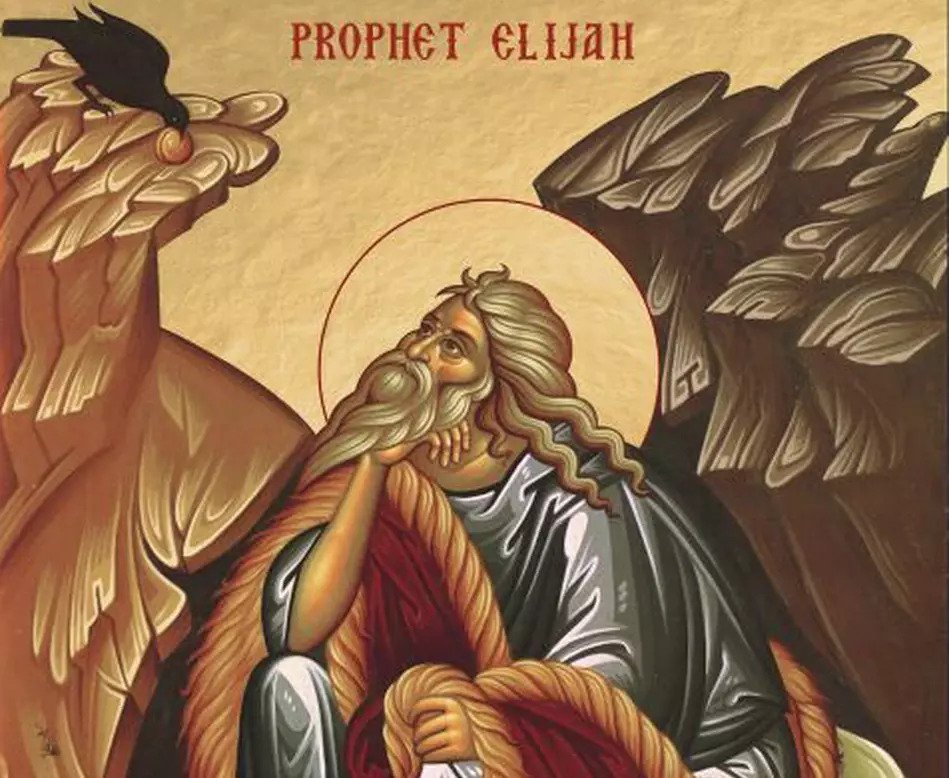
Elijah is most famous for two incidents that follow today’s story– one is a face-off with the prophets of Baal Hedad, a Mountaintop Battle of the Gods that lasts a whole day, during which Elijah taunts them relentlessly, and the Baal fails to deliver even a spark. Yahweh and Elijah come out on top when Yahweh’s fire from heaven vaporizes Elijah’s waterlogged sacrifice, altar included. Then Elijah takes things too far and slaughters the prophets of Baal. He immediately goes from speaking for God to cowering from the empire when Queen Jezebel threatens him and he flees for his life, bringing us to the second story Elijah is most known for. Wandering desperate and terrified through the wilderness he ends up in a cave, crying out to God. God sends a great wind, and a storm, and an earthquake, but God is not in the wind, or the storm or the earthquake, and then there is the sound of sheer silence. And this is where God meets Elijah. Speaking to him in the still, small voice. 

Those seem like significant stories, and the public showdown between Yahweh and Baal is a real boon to Elijah’s prophetic reputation. But the story we have today seems minor and unimportant. A miracle, for certain, but why is it recorded in the annuls of Kings? Why is it placed alongside stories that shaped the direction of history?

It helps to know something about the Ancient Near East. That there were many gods was simply accepted as fact, there was no alternative to polytheism, that’s just how it was for all peoples everywhere. When people groups mingled, they welcomed in each other’s gods and added them to their own collections. Different gods for different things, hierarchies of gods or their exact names—you might quibble about those details, but you would never question the array and assortment of deities. Scholars tell us that shifting from worshiping many gods to worshiping only one God was gradual – going from worshiping many gods to acknowledging them but worshiping only Yahweh, to not mentioning other gods at all, to finally saying only Yahweh is God and always has been, and there are no other gods—that process takes time, like, hundreds of years of gradual shifting.

So, Elijah is part of this shifting, moving people from worshiping many gods to worshiping Yahweh alone. King Ahab loves worshiping Yahweh, but he just mixes Yahweh up into his collection of other gods and can’t see what’s wrong with that. Only the Israelite kings did this, by the way. Outside of Israel, Yahweh was wildly unpopular, because a god who claims to be the only one does not play well with others.

So when God tells Elijah to tell King Ahab it won’t rain for three years until Yahweh says so, Yahweh is stepping into the realm of the Canaanite god of rain, fertility, growth, and increase- Baal Hedad.  In the way of the empire, the peasants work the land, the king reaps the benefits, and everyone behaves, accepting the way things are, and staying in their proper place. The temples to the rain god are in the cities where it matters, so the rain will fall specifically on the farms of the king, to feed his crops and increase the wealth of the wealthy.

But Yahweh is the God of all, with no distinction or preferences – except perhaps for the overlooked and undervalued. So, Yahweh turns off the faucet.

The law of Moses says God has called each person to know and follow God. All shall be given land, and if they don’t have it, then land and resources should be redistributed so everyone has what they need. People are commanded to look out for each other, and especially to take care of the oppressed and those on the margins, lifting up the poor, the widow and the orphan. Every person is part of God’s story and God has claimed them to be a blessing to the whole world.

But this empire structure King Ahab slides into props up the few by oppressing the many, consolidates power, tramples the weak, plunders the land, dehumanizes human siblings in the insatiable pursuit of more and more in a structure of fear and dominance, competition and scarcity, what we’ve called the way of fear. 

Not only is the one true God too big to be just one of many self-serving deities of the empire that we capitulate to, but the way of God is is in direct opposition to the whole empire thing altogether. Humans are made in the image of God to care for one another, to steward and tend the earth and its creatures, to enjoy life together in the presence of God, in an intricate and astounding world of interdependence, held in a relationship of trust and promise. Yahweh alone is God.

So, against that backdrop, here comes this little story.  After delivering his message of drought to the King, Elijah is sent by God to hang out by a drying up wadi (or creek), and told God will provide. And indeed, God does – never without a sense of humor, using ravens, an unclean bird, to bring food to him, because, remember? God is Lord of all, not even captive to our ideas of God, and is free to do what God wishes. So why not shake it up? Ravens it is! When the creek dries up God sends Elijah some 50 miles away to find this one, particular widow, whom God says will provide food and water for him. 

But when he finally gets there, famished, the lady seems not to have gotten the message. She’s willing to give him a bit of water, but when Elijah asks for food she says, (more bluntly than the Peace Table puts it), “I have enough oil and flour to make my son and me one last scrap of food and then we will lay down and die.” And Elijah has the nerve to ask her to feed him first. He promises the ingredients won’t run out. So, she does, and they don’t. 

And when I hear this, I don’t think, how wonderful! I think, how dare he ask her for that? She’s poor! She needs it way more than he does because she has a kid to feed too! There is only so much to go around! And to give it to some you must deny it to others. If he were really a good person, really from God, he would never demand something from someone who has so little!

And there is the voice of the empire within me! The empire imagination that keeps the peasants in their place and views the world through scarcity and competition. Exactly what the prophetic imagination comes to confront and expunge.

Why does this story matter? Here’s why: Because we too have been coopted by the empire to accept the unacceptable. We’re terrified when the status quo gets rocked and shaken, and the built gets unbuilt, because while it might not be perfect, at least it feels stable. It may be rotten with injustice and inequality, but at least we know how much eggs will cost. And the many gods we worship – gods of security and protection, gods of image and achievement, gods of wellness and longevity that we sacrifice to to keep the world from shaking so we can eek our way forward without much tumult or upheaval – when they fail us, and our 401Ks plummet, it’s terrifying.  We don’t want an unbuilt and rebuilt reality. As much as we call ourselves Christians, we don’t actually want a death and resurrection kind of God, a God who comes in weakness and shares suffering and invites us to see one another and share life with each other come what may and trust that God will meet us there and hold us fast. We want the empire, plain and simple. 

But this little story calls us back to the way of God, not by the prophet’s bold declaration but by his hunger and need. Yahweh is a God who provides. A manna in the wilderness God gives enough for the next meal, and the one after that, if we share it with one another. Not enough to increase and hoard, to rely on our own strength, power or cunning over and against one another. But enough to keep us operating in the currency of covenant, that is, trust and promise. 

The widow must trust Elijah, and must trust the promises of Yahweh through him. Elijah must trust God to provide and the kindness of this woman. He must entrust himself into God’s hands by entrusting himself into her hands. And she seems an unlikely source of security, indeed, not who you’d expect to provide for your needs because she apparently can’t even provide for herself or her son.  But when Elijah asks ‘the least of these’ for help, he elevates her from irrelevant object of pity to Provider of Hospitality. He comes to her in need of care, and sees her as able to care for him, even if she can’t at first see herself that way. And suddenly they are both freed from the empire. They are living the law of Moses, where all are neighbors, siblings in the human family, looking out for each other, and Yahweh is God of us all, promising to hold us and uphold us.

And so, Elijah gets to live the message he will go on to proclaim: There is only one God, this one, Yahweh, alone, who provides all we need and brings life out of death. This is whose we are. And we are called by this God to be a blessing to the world in our mutual care for one another. That is who we are.

There is nothing more destructive in all the earth than human beings forgetting our belonging to God and each other. And very often we just mix up Yahweh into our collection of other gods and get on with our empire-living. But we are the prophetic community, called to recall God’s faithfulness in the past, premember the future God is bringing, and join right now, from our weakness and need, in the kingdom of the living God unfolding here among us and between us, trusting the God of resurrection to meet us in our places of death. 

So, dear ones, may live the message we proclaim, hear within the silence the still, small, voice, and rest in the hammock of trust.

Amen. 

What Jesus does with my malice

Matthew 22:15-22 There are certain public figures who, from time to time, I give a lot of my attention to. Their actions stir my rage. They ...