Showing posts with label Elijah. Show all posts

Sunday, March 16, 2025

To Hold and Uphold


1 Kings 17:1-16

One unfortunate thing about being human over, say, a bird, or a dog, is that humans tend to forget whose we are and who we are. The prophet’s job is to remind us. They create a kind of the hammock of trust suspended between recalling God’s faithfulness in the past, and premembering the future God is bringing. The is essential, because there is nothing more destructive in all the earth than human beings who’ve forgotten their belonging to God and each other.

The prophet Elijah appears out of nowhere, bursting on the scene fully formed, ready to show the people of Israel who is the real God. In those days, in the other lands, prophets were a dime a dozen. People who delivered messages between the divine realm and the world of humans camped out in temples near idols like buskers with their hat on the ground.  

So when God calls prophets in Israel, one scholar says, we can think of God ‘using the technology of the day’ – people understood the idea of prophets. But the prophets of Israel weren’t street performers; they were honored guides, whose words were collected and recorded (the Israelites basically invented scripture). Messengers of Yahweh who spoke truth to power, the prophets reminded the kings that God’s covenant calling and the law of Moses applied equally to all people, kings included. 

Also, just to be clear, the prophets were weird. Pretty much all of them. The stories are wild, all performance art and poetry, confusing and disruptive. Not really the buttoned-up lawyer-type, they were more the off-the-grid, loud and raving type, the blunt objects God uses to break through the status quo and tear it all down when the people of God lose their way, imaginations dulled and senses numbed into accepting the unacceptable. This story of unbuilding and rebuilding repeats again and again.  So, the Hebrew prophets were both revered and a little bit feared, because they were unpredictable and a little bit dangerous, not quite housebroken, demonstrating Yahweh couldn’t be domesticated either. 

There are 133 named prophets in the bible, 16 of them women. Many spoke God’s words, but some of also performed miracles, these were known as ‘men of God’. Elijah, and his apprentice Elisha, were the most well-known ‘man of God’ types, conduits of the Divine who demonstrated God’s power with works of wonder.  

Elijah is most famous for two incidents that follow today’s story– one is a face-off with the prophets of Baal Hedad, a Mountaintop Battle of the Gods that lasts a whole day, during which Elijah taunts them relentlessly, and the Baal fails to deliver even a spark. Yahweh and Elijah come out on top when Yahweh’s fire from heaven vaporizes Elijah’s waterlogged sacrifice, altar included. Then Elijah takes things too far and slaughters the prophets of Baal. He immediately goes from speaking for God to cowering from the empire when Queen Jezebel threatens him and he flees for his life, bringing us to the second story Elijah is most known for. Wandering desperate and terrified through the wilderness he ends up in a cave, crying out to God. God sends a great wind, and a storm, and an earthquake, but God is not in the wind, or the storm or the earthquake, and then there is the sound of sheer silence. And this is where God meets Elijah. Speaking to him in the still, small voice. 

Those seem like significant stories, and the public showdown between Yahweh and Baal is a real boon to Elijah’s prophetic reputation. But the story we have today seems minor and unimportant. A miracle, for certain, but why is it recorded in the annuls of Kings? Why is it placed alongside stories that shaped the direction of history?

It helps to know something about the Ancient Near East. That there were many gods was simply accepted as fact, there was no alternative to polytheism, that’s just how it was for all peoples everywhere. When people groups mingled, they welcomed in each other’s gods and added them to their own collections. Different gods for different things, hierarchies of gods or their exact names—you might quibble about those details, but you would never question the array and assortment of deities. Scholars tell us that shifting from worshiping many gods to worshiping only one God was gradual – going from worshiping many gods to acknowledging them but worshiping only Yahweh, to not mentioning other gods at all, to finally saying only Yahweh is God and always has been, and there are no other gods—that process takes time, like, hundreds of years of gradual shifting.

So, Elijah is part of this shifting, moving people from worshiping many gods to worshiping Yahweh alone. King Ahab loves worshiping Yahweh, but he just mixes Yahweh up into his collection of other gods and can’t see what’s wrong with that. Only the Israelite kings did this, by the way. Outside of Israel, Yahweh was wildly unpopular, because a god who claims to be the only one does not play well with others.

So when God tells Elijah to tell King Ahab it won’t rain for three years until Yahweh says so, Yahweh is stepping into the realm of the Canaanite god of rain, fertility, growth, and increase- Baal Hedad.  In the way of the empire, the peasants work the land, the king reaps the benefits, and everyone behaves, accepting the way things are, and staying in their proper place. The temples to the rain god are in the cities where it matters, so the rain will fall specifically on the farms of the king, to feed his crops and increase the wealth of the wealthy.

But Yahweh is the God of all, with no distinction or preferences – except perhaps for the overlooked and undervalued. So, Yahweh turns off the faucet.

The law of Moses says God has called each person to know and follow God. All shall be given land, and if they don’t have it, then land and resources should be redistributed so everyone has what they need. People are commanded to look out for each other, and especially to take care of the oppressed and those on the margins, lifting up the poor, the widow and the orphan. Every person is part of God’s story and God has claimed them to be a blessing to the whole world.

But this empire structure King Ahab slides into props up the few by oppressing the many, consolidates power, tramples the weak, plunders the land, dehumanizes human siblings in the insatiable pursuit of more and more in a structure of fear and dominance, competition and scarcity, what we’ve called the way of fear. 

Not only is the one true God too big to be just one of many self-serving deities of the empire that we capitulate to, but the way of God is is in direct opposition to the whole empire thing altogether. Humans are made in the image of God to care for one another, to steward and tend the earth and its creatures, to enjoy life together in the presence of God, in an intricate and astounding world of interdependence, held in a relationship of trust and promise. Yahweh alone is God.

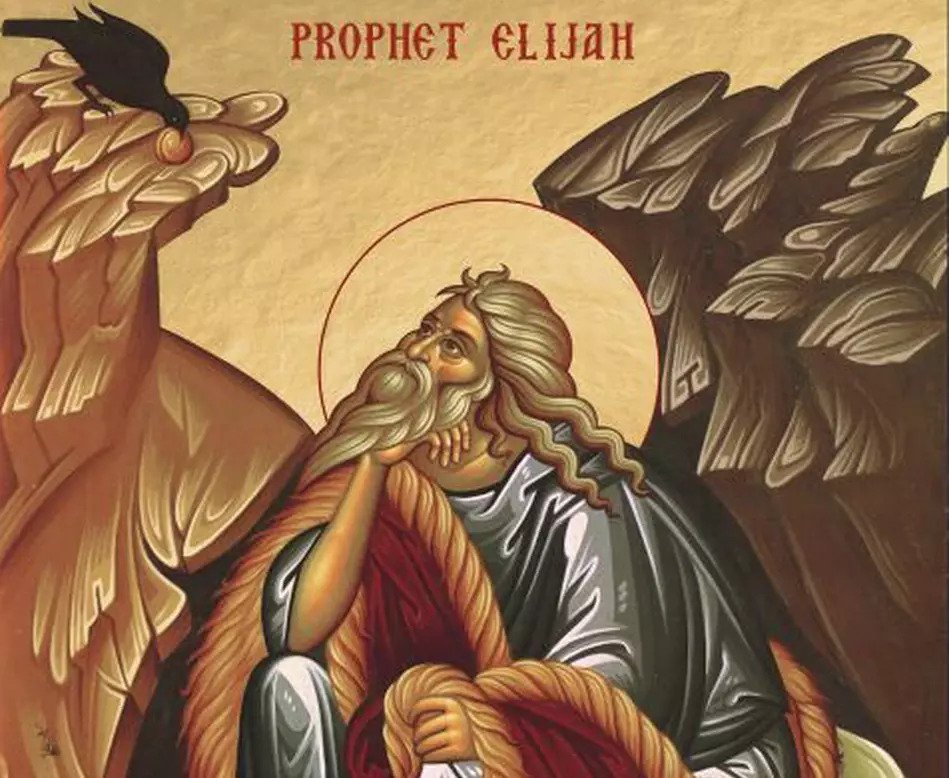
So, against that backdrop, here comes this little story.  After delivering his message of drought to the King, Elijah is sent by God to hang out by a drying up wadi (or creek), and told God will provide. And indeed, God does – never without a sense of humor, using ravens, an unclean bird, to bring food to him, because, remember? God is Lord of all, not even captive to our ideas of God, and is free to do what God wishes. So why not shake it up? Ravens it is! When the creek dries up God sends Elijah some 50 miles away to find this one, particular widow, whom God says will provide food and water for him. 

But when he finally gets there, famished, the lady seems not to have gotten the message. She’s willing to give him a bit of water, but when Elijah asks for food she says, (more bluntly than the Peace Table puts it), “I have enough oil and flour to make my son and me one last scrap of food and then we will lay down and die.” And Elijah has the nerve to ask her to feed him first. He promises the ingredients won’t run out. So, she does, and they don’t. 

And when I hear this, I don’t think, how wonderful! I think, how dare he ask her for that? She’s poor! She needs it way more than he does because she has a kid to feed too! There is only so much to go around! And to give it to some you must deny it to others. If he were really a good person, really from God, he would never demand something from someone who has so little!

And there is the voice of the empire within me! The empire imagination that keeps the peasants in their place and views the world through scarcity and competition. Exactly what the prophetic imagination comes to confront and expunge.

Why does this story matter? Here’s why: Because we too have been coopted by the empire to accept the unacceptable. We’re terrified when the status quo gets rocked and shaken, and the built gets unbuilt, because while it might not be perfect, at least it feels stable. It may be rotten with injustice and inequality, but at least we know how much eggs will cost. And the many gods we worship – gods of security and protection, gods of image and achievement, gods of wellness and longevity that we sacrifice to to keep the world from shaking so we can eek our way forward without much tumult or upheaval – when they fail us, and our 401Ks plummet, it’s terrifying.  We don’t want an unbuilt and rebuilt reality. As much as we call ourselves Christians, we don’t actually want a death and resurrection kind of God, a God who comes in weakness and shares suffering and invites us to see one another and share life with each other come what may and trust that God will meet us there and hold us fast. We want the empire, plain and simple. 

But this little story calls us back to the way of God, not by the prophet’s bold declaration but by his hunger and need. Yahweh is a God who provides. A manna in the wilderness God gives enough for the next meal, and the one after that, if we share it with one another. Not enough to increase and hoard, to rely on our own strength, power or cunning over and against one another. But enough to keep us operating in the currency of covenant, that is, trust and promise. 

The widow must trust Elijah, and must trust the promises of Yahweh through him. Elijah must trust God to provide and the kindness of this woman. He must entrust himself into God’s hands by entrusting himself into her hands. And she seems an unlikely source of security, indeed, not who you’d expect to provide for your needs because she apparently can’t even provide for herself or her son.  But when Elijah asks ‘the least of these’ for help, he elevates her from irrelevant object of pity to Provider of Hospitality. He comes to her in need of care, and sees her as able to care for him, even if she can’t at first see herself that way. And suddenly they are both freed from the empire. They are living the law of Moses, where all are neighbors, siblings in the human family, looking out for each other, and Yahweh is God of us all, promising to hold us and uphold us.

And so, Elijah gets to live the message he will go on to proclaim: There is only one God, this one, Yahweh, alone, who provides all we need and brings life out of death. This is whose we are. And we are called by this God to be a blessing to the world in our mutual care for one another. That is who we are.

There is nothing more destructive in all the earth than human beings forgetting our belonging to God and each other. And very often we just mix up Yahweh into our collection of other gods and get on with our empire-living. But we are the prophetic community, called to recall God’s faithfulness in the past, premember the future God is bringing, and join right now, from our weakness and need, in the kingdom of the living God unfolding here among us and between us, trusting the God of resurrection to meet us in our places of death. 

So, dear ones, may live the message we proclaim, hear within the silence the still, small, voice, and rest in the hammock of trust.

Amen. 

Sunday, October 18, 2015

Answer us, O Lord


Once upon a time, there was a prophet in the northern kingdom of Israel named Elijah. A man of God, fearless and brave. He used to confront King Ahab and his wife, a priestess and daughter of a foreign king, Queen Jezebel, and Elijah caused all sorts of upset for them in the kingdom.

One day, a most famous incident occurred.  Elijah the prophet proposed a face-off between the God of Israel, Yahweh, and the god that Jezebel had imported in and Ahab had propped up alongside Yahweh, Baal.  The showdown was epic, on the top of a mountain everyone gathered, 450 prophets of Baal on one side, Lone Elijah on the other.

Get your god to answer, was the challenge.  Set up a sacrifice and get your god to show up.  Whoever does is the real god.  Up first, the prophets of Baal, the god of lightening and fire.

They cut up their ox and laid it on their alter with firewood underneath and began begging Baal to start it on fire.  All morning long they pleaded, throwing themselves down, imploring, urging, cutting themselves, whatever they could think of to make it happen. 

Around noon Elijah started taunting them. “Maybe your god is away on a long vacation! You’d better call louder, he’s probably sleeping! Wait! Maybe he just can’t hear you because he’s meditating!”  All the while, these prophets worked themselves into a frenzy, but their god stayed silent – there was no voice, no answer, no response.

Finally Elijah calls it, my turn.  
So he sets up stones representing the 12 tribes of Israel and digs a trench around his alter, and asks for water to be dumped on top of the whole thing, sacrifice, wood and all.  Is it wet?  Better add some more!  He asserts.  How about now? Better soak it a third time for good measure!  And soon the whole thing is utterly drenched with the moat full around it.

Then he prays to Yahweh a polite little prayer, that went something like: 
‘O Lord, God of Abraham, Isaac, and Jacob, let it be known this day that you are God in Israel, that I am your servant, and that I have done all these things at your bidding. Answer me, O Lord, answer me, so that this people may know that you, O Lord, are God, and that you have turned their hearts back to you.’

And in front of their eyes, the fire of the Lord fell and consumed the burnt-offering, the wood, the stones, and the dust, and even licked up the water that was in the trench. When all the people saw it, they fell on their faces and said, ‘Yahweh indeed is God!; Yahweh indeed is God!.’

God showed up in fire.  And Elijah, the man of the hour, took his bow and then chased away the prophets of Baal, cornering them in a valley, and with his sword, invincible Elijah killed all 450 of them.  That was his most famous triumph.

And we could stop the story there.
Yahweh indeed is God! Baal is not god!
Only God is God – and the truth is, there are plenty of things to ponder in this tale, such as, Why do the Israelites, and we, have such short memories? 
Why is it so easy to forget who we are and whose we are?
Hear, O Israel: The Lord is our God, the Lord alone. You shall love the Lord your God with all your heart, and with all your soul, and with all your might.
Amen.

And Elijah, the storybook hero, brought the lesson home.  
Sermon done.

But there is something fascinating about the next day, you know what I mean? 
The moment after the invincible moment. When the curtain goes down and spotlight turns off and the applause dies and the adrenaline wears off… after the bravado and bravery.
Who is Elijah, then? Whose is he?
What happens just after this epic moment in the life of the prophet and the nation of Israel is technically just after our text for today, but I’m the preacher, so I’m going to allow it.

With the taste of his victory speech still on his tongue, the blood of his enemies still on his sword, and the legend about him building already: Once upon a time there was this great and mighty prophet, Elijah, who had God’s ear and stood up to an evil King and Queen and singlehandedly slayed an army of liars and showed everyone who the real God is!  
Elijah is feeling all right, for about five minutes.  

But then, the king tells Queen Jezebel what happened that day, and the Queen sends Elijah this chilling message: “I’m gonna get you.” 

And this big brave man runs. 
He flees. Deep into the wilderness. 100 miles he goes, driven by terror he recklessly races as fast as his legs can take him as far as he can go into nothingness, and he collapses under a single broom tree in the middle of the parched desert.  “O God! he cries out, “just kill me now!”

But God pays no mind to his drama.
“Get up and eat,” says an angel, startling him from sleep and giving him a cake cooked on a hot stone next to him. So he eats and then he sleeps again, fitfully, fearfully, and when he awakens an angel is there again, ready to feed him.  “Eat this or you wont have strength for the journey that’s ahead of you.”

And huddled there, in the wilderness, Elijah is a mess. 
For all the strength he’s just exhibited, Elijah feels anything but strong. For all his boasting and might, when he heard Jezebel was after him he ran for his life. With the triumph quickly worn off and his bloodstained hands mocking him as Jezebel’s warning rings in his ears that she would do to him what he did to them, he finds himself crouched up under a scraggly broom tree in the wilderness wondering what it is all for anyway.

Elijah feels like a failure, a frightened, weak, empty failure. It doesn’t get any grander than what had just happened, so why does he feel so badly about it?  It doesn’t get more final than having everyone bow down to God, so why has it seemed to just go back to the way its been, Jezebel breathing down his neck, Ahab too weak to stand up for the god of Israel? Elijah feels alone – oh so alone.  He feels alone and tired and very, very afraid. 

So he flees to the harsh solace of the wilderness.  And he asks to please die. Please just kill me, God. 
But God is silent on the matter.  Doesn’t answer any of his whining or begging, doesn’t hear his arguments.  Instead, like a mommy with a sick kid, God lets him sleep, wakes him to feed him in spite of himself, tells him to get up his strength, and then when he is ready, God sends him on a journey. Deeper into the wilderness, further into his questions.

“What are you doing here, Elijah?”

“Oh God.  I’ve tried so hard but I’ve failed, I’m alone, I can’t do it. And they’re going to get me.”

“Let me show you myself,” God says.

So God leads him up to a mountain cave, a cave on the very mountain where Moses received the Ten Commandments.  And as he huddled there, there came a wind so great that it split mountains and broke apart rocks, but Yahweh was not in the wind. 
And after the wind an earthquake, but Yahweh was not in the earthquake,
and after the earthquake a fire, but this time Yahweh was not in the fire,
and after the fire,
a sound of sheer silence.

He has seen the God of might, he has reckoned with the God of power. He has just watched God send down fire from the sky in front of everyone in a show of undeniable, crushing might.   
But not here.  That isn’t how God meets Elijah in the wilderness. In the wilderness when all displays of power blow over, and all recognizable godlike rumbles die down, and he is left with a vacuum, an emptiness, a vast, quiet nothingness – it is here that God meets Elijah.

When God is silent. 

I love the bible. I love it for not leaving Elijah a strong hero and God a powerful, invincible force.  For the prophet’s complete loss of faith just after the ultimate display of faith, I love it.  For the messiness and confusion and refusal to leave things in storybook form.  For God’s tenderness and gentle care in the midst of Elijah’s breakdown and fear, I am thankful.  For the way God remains mystery and will not be boxed in, for God’s might and noise and for God’s deep silence, neither one canceling out the other, I love that this is the glimpse we get into the mystery that holds us.

Yaweh’s silence is different than the silence of Baal to the prophets’ pleadings.  It isn’t the inanimate silence of your own efforts bouncing back at you; it isn’t silence dependent on your own ability to keep it, or fill it, or explain it away. 
When Yaweh is silent it is like deep calling to deep – it is the sound of the great I AM, that no despair, no fear, no horror or godforsakenness ever dreamed up could ever swallow or overpower.  In the absence of sound, I AM, in the vacuum of light, I AM, in the loss of all hope, I AM: there is nothing that can drive me away. 

The mountaintop victory showed everyone else that God is real, but for Elijah, it was the utter silence on the other mountaintop that turned his heart back to God.

Sometimes what we need is the fire, the all-consuming proof that God is indeed alive and right here today.  I heard a miraculous story this week of a person coming back from the dead from a heart attack just after arriving at a hospital, while his friend listened to the whole thing on the other end of a cell phone call, pulled over in a ditch with his car door still open, on his knees in the tall grass praying frantically to God for his friend’s healing.  And God showed up in the fire and the drama, as his heart was shocked back to life on the other end of the line, and the interceding friend listened to his prayers being answered in real time. 

But I also heard this week about a friend who found her only solace in the silence of salt water tears on a surfboard in the rolling ocean, carried into the place of deep calling out to deep, where grief and pain came pouring out and God’s vast absent presence wordlessly surrounded her even while not bringing back her dead brother.

“What are you doing here, Elijah?”

Oh God.  I’ve tried so hard but I’ve failed, I’m alone, I can’t do it. And they’re going to get me.

“Go, Elijah, return through the wilderness…and go back.”

Elijah obeyed and went back. And God showed him that he was not alone, there were 7000 people who still worshiped Yahweh in Israel. And he spoke out and anointed kings and was a great prophet until the day he was taken into heaven. 

And I imagine that for the rest of his days, while the world remembered him for the show of power in the mountain-top duel of the deities, he felt most defined by the life-changing encounter on the empty mountain with the silent God.

Our own idolatry can replace God, or it can rewrite God.  
We can have an impotent god who leaves it all up to us, a distant god, uninvolved and vacant, a god who needs his ego stroked or his hoops jumped through.
We can make god in our own image, judgmental and harsh, wishing we were not such a perpetual disappointment.  
Or we can replace or supplement God with the things that give us more immediate gratification, or credibility with others, or the impression of security in a shaky world - like the polytheists in Israel, paying lip service to the divine while serving our own satisfaction instead.

But God is real, my friends.  Quite apart from us, God exists.  God is free to encounter us, or not, free to act, or not, free to show up like we think God should, or not.  God is powerful enough to meet us in stunning strength or in sheer silence.  And God is able to know what we need better than we are.

Sometimes we are in our confidence and faith, standing before adversity and declaring the might and power of our God. And sometimes we are fleeing in terror, alone, exhausted and distraught, begging for God to just end it.  Either way, this truth remains: The Lord is our God, the Lord alone. Sisters and brothers, that is whose we are. 

And we shall love the Lord our God with all our heart, and with all our soul, and with all our might. That is who we are. 

And so, we pray, along with Elijah, Answer us, O Lord, answer us, so that this people may know that you, O Lord, are God, and that you have turned our hearts back to you.’
Amen.


My plan for Election Day

My plan for Election Day  (by Pastor Kara) 1- I will Vote. 2- I will see and value my fellow citizens, and especially our poll workers.  I...