
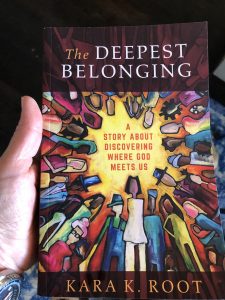
I wrote an article for Faith+Lead about our new book and my sabbatical.

Psalm 4
Answer me when I call, O God of my right!
You gave me room when I was in distress.
Be gracious to me, and hear my prayer.
How long, you people, shall my honour suffer shame?
How long will you love vain words, and seek after lies?
Selah
But know that the Lord has set apart the faithful for himself;
the Lord hears when I call to him.
When you are disturbed, do not sin;
ponder it on your beds, and be silent.
Selah
Offer right sacrifices,
and put your trust in the Lord.
There are many who say, ‘O that we might see some good!
Let the light of your face shine on us, O Lord!’
You have put gladness in my heart
more than when their grain and wine abound.
I will both lie down and sleep in peace;
for you alone, O Lord, make me lie down in safety.
There’s a desperate vigilance and awful heaviness about the world at the moment. I think even if we aren’t paying super close attention, many of us are still feeling it. A shared, psychic weight to the world. Even as we are hurriedly vaccinating people, the case numbers are rising toward a global highest point, and what, another mass shooting? Wasn’t there just one yesterday? The pressure feels audible, the tension palpable. So many people I know have commented on how utterly exhausted they feel. But at the same time our sleep is fraught and spotty. We are alert, restless and exhausted.
It feels like we’re given two options, and neither one is tenable. One is to watch every minute of the Derek Chauvin trial, read everything we can about little Adam Toledo, break apart the video of Daunte White’s killing, stay up late watching national guardsmen teargassing journalists a few miles away from us, track the vaccinations, stay on top of the politicians, check in on the suffering children at the border and the conflicts simmering all over the globe, worry about the threat of climate change, and compulsively wonder what more we should be doing. And if we are not out marching or speaking out then we are following those who are, because we need to feel like we are doing something, like something is being done that can stop all this, or fix all this, and Lord, it’s all so awful how can we ignore even a moment of it?
The other option we’re given is to go numb and limp. To shut it all off, and block it all out, and take in nothing but our own lives and desires. And maybe we occasionally feel a teeny bit guilty, but that’s better than helplessness and rage with no outlet. And sometimes we just bounce wildly back and forth between the two.
But there is a third way. And I think this Psalm gives it to us.
It starts with lament. When the tears feel close, and sorrow claws up the throat, and anger and rage are right here next to us, we aim all of that right at God. We moderns are pretty scared of lament in church, preferring the more palatable confession, but lament is an integral part of our faith. And this particular lament of David, we know, was sung in community, all the voices crying out together, Answer me when I call to you God! How long will this go on?
There is a mystery word here that shows up 71 times in the psalms and twice in Habakkuk, Selah. Because it’s very close to the word for pause, and also the word for praise, throughout the millennia it has come to be seen as a kind of mix of both - pause and praise God. Take a beat and turn your attention back to God.
So built right into the song is a pause, everyone stopping, silent, shifting focus back to God. And then continuing on in unison.
So hear the Psalm again, in this paraphrase:
O God who knows me, answer me when I call!
When I have been confined in anxious misery before,
you’ve opened up expansive space for me to breathe,
please hear me now; give me your grace again.
How long will our humanity be torn down?
How long will lies be elevated,
and people spread vitriol, delusion and exploitation?
Stop.
Take a beat.
Turn your attention to God.
God has drawn us to God’s own being,
those who seek God are claimed for God’s purposes.
When you are worked up and distraught,
don’t turn to division and blame; don’t tear down others.
Instead, sit in it with God,
be silent in a restful space.
Stop.
Take a beat.
Turn your attention to God.
Lay everything before the Almighty in vulnerable honesty,
and trust God with it.
So many people say, “There is no goodness that we can see!”
Oh Lord, let your love and truth shine on all of us!
You have filled me with deep joy,
more happiness than when they have all the wealth
and satisfaction they desire.
I won't stay up babysitting the world,
I will sleep soundly and deeply
because this your world, God,
and my life is held in you.
Lament. Return to God. Then remember.
This earth is heavy with sorrow and need.
And at the same time this planet turns slowly in the utter silence of the vast cosmos, nestled amongst the great lights of burning stars, held in orbit to the sun. And within this planet, while one hemisphere is nestling down in winter hibernation, here the green shoots push up through the soil, and trees are awakening. And all over the planet new babies are born, and broken relationships are mended, and people are tending to each other, and there is laughter and joy, and tears of deep connection, and healing, and hope, and love remains the most powerful force in the universe, always at work, always, always, always.
But oh! We forget. So quickly, without realizing it, even when we’re trying to remember.
This happened to me yesterday. I was remembering, and then I was completely derailed when I read in a commentary from 2012 (Shauna Hannan, Working Preacher) that in the first verse, where it says, you made space for me it originally alluded to “release from a tight noose at the neck,” the opposite of the word for when I was in distress, which is used for “a constricted larynx.” And I stopped hearing the promise of God’s deliverance and the invitation to trust, and all I could see was that God did not make space for George Floyd when he was in distress, and how could I preach this text in the shadow of that?
All day long I spun out, all day long I fixated on my words, the overwhelming sorrow and brokenness of this world, the pain of our city. I did not lament. I obsessed. I did not take my anguish and sit silently before God. I logged onto the news and social media and started babysitting the world again. I did not come in honesty before the Almighty. I got caught up in blame and frustration in the country, and became controlling and edgy in my own house.
And then I looked at the clock and realized it was time for evening prayers.[1] So I sat down on zoom with those who meet together every evening.
Stop. Take a beat. Turn your attention to God.
And suddenly there was joy, in sharing about a day spent with happy little cousins, and our delight and horror at a ridiculous amount of accidentally purchased bananas.[2] Suddenly God was meeting us right there in our humanity, in our need, in our coming together. Then one of them repeated back to me that love is the most powerful force in the universe, and I was invited back into trust.
We are meant to stand with one another and for each other, to hold each other and fight for life for each other and us all, for this whole beautiful and broken world. We are made for love. God calls us into God’s purposes; we are drawn into God’s own being. We get to share in the love God is already, always bringing.
And then, at the end of the day, we sleep.
To sleep is to yield to our most essential humanity – our creaturliness, our need, our soft, vulnerable, universal humanity, the warm breath, closed eyes, heavy limbs of us.
Sleep is trust. It is pure being. Sleep is admitting we are not God. Sleep returns us to the humility of our own humanity. Only from here can we be fully in this life, with and for each other.
We belong to God. This is God’s world. God made it. God came into it to bear our suffering and share our pain and take on our death so that death cannot, will not define us, will not have the last word, will not prevail.
So stop. Take a beat. Turn your attention to God.
There is a poem by Pablo Neruda that I love, called Keeping Quiet. It goes like this:
Now we will count to twelve
and we will all keep still.
For once on the face of the earth
let’s not speak in any language,
let’s stop for one second,
and not move our arms so much.
It would be an exotic moment
without rush, without engines,
we would all be together
in a sudden strangeness.
Fishermen in the cold sea
would not harm whales
and the man gathering salt
would look at his hurt hands.
Those who prepare green wars,
wars with gas, wars with fire,
victory with no survivors,
would put on clean clothes
and walk about with their brothers
in the shade, doing nothing.
What I want should not be confused
with total inactivity.
Life is what it is about;
I want no truck with death.
If we were not so single-minded
about keeping our lives moving,
and for once could do nothing,
perhaps a huge silence
might interrupt this sadness
of never understanding ourselves
and of threatening ourselves with
death.
Perhaps the earth can teach us
as when everything seems dead
and later proves to be alive.
Now I’ll count up to twelve
and you keep quiet and I will go.”
Christ has risen. He is risen indeed.
Death does not get the last word, and love is the most powerful force in the universe.
May we join in fully. And may we sleep soundly.
Amen.
[1] At this time, Pastor Lisa and I were praying every morning and evening, and the congregation every Sunday night, over zoom, with a family navigating mom's cancer.
[2] In my first foray into online grocery shopping, rather than 14 single bananas, I’d inadvertently bought 14 2lb bunches of bananas.

It goes so fast. All of it.
Years ago I read the article below and I kept it for its sabbath wisdom, for the way it invites me to live in time and to pay attention. These fleeting few days a year, the lilacs' heady odor fills my yard, seeps through the open windows of my home, and even blankets me in my bed as I sleep. Lilacs have become for me another way to mark time, to live in gratitude.
I've missed the lilacs before. This year I'm here for it.
LIFE & LILACS
June 22, 1996 | ELLEN GOODMAN and Boston Globe
The lilacs have gone by. I take note of this with an unexpected snap of regret as I take my morning commute from the kitchen to the driveway.
The flowers had made their annual appearance on the bushes that stand beside my backdoor. For two weeks, they had permeated the air with a seductive promise.
I planned to take up their offer, to spend time in their company. But now the last of the blooms has turned a crusty deadhead shade of beige. And I had paid only the most transient of visits, enjoyed only a contact high, a small whiff of their possibilities.
This morning, it is the absence of lilacs that finally stops me in my tracks. I brake belatedly to pay the toll of attention to what is now missing. A year’s worth of lilacs, an entire life span of flowers.
I repeat the phrase in my mind: The lilacs have gone by. It is what gardeners say. But in fact, the lilacs stayed in one place and I had gone by them, hurrying, on the way, on the move.
Behind me in this small city garden there are irises in bloom. The peonies are on the way, the ants already feasting the sweet sap off their buds. They will be followed by day lilies and black-eyed Susans, by asters and fall. Is it seasonal, this consciousness of the racing pulse of daily life? Is the awareness of flowers “going by” more than a banal metaphor for transience? Is it, rather, some alarm coded into our DNA as if it were a clock?
The days are still lengthening, but lately my friends have been wistful about time, the common currency of their lives. They talk of spending too much time on what are dubbed essentials. Too many hours seem to be taken out of their week, as if the week were a paycheck, too much withheld before they get to some small luxury, a moment of discretionary spending.
At lunch last week, a woman not given to maudlin cost accounting had figured out on her actuarial table that she has probably 30 more chances to see the pink ladyslippers in the woods. Thirty is a lot said the woman who is approaching 50 herself. But it is also, suddenly, finite.
This morning, dangling out of my briefcase is a plastic bag of excess black-eyed Susans that I dug up in a rush last night. Flowers for a friend. On the phone last week, we talked about the sense of channel-surfing through life. Work, click, kids, click, parents, click, errands, click. With split-second timing it was possible to cover everything – but only if we stay on the surface. What happens when life becomes a list, we asked each other? When even the pleasurable things become items to check off? What happens when we are getting through the days? What are we getting through and to? But our thoughts were interrupted by call-waiting.
Sometimes, you catch a glimpse of something in human nature that longs to spend time lavishly. To relish as well as to produce. On a late spring morning, there is a wistful reminder in this natural datebook. How quickly things “go by.” Life and lilacs.
My friend Lilly Lewin is in Scotland, lucky Lilly. She has asked me to cover one of her regular "Freerange Friday" posts on Godspace while she is away.
Here is my article on Sabbath, shared with that community.
The Gift and Lesson of Sabbath Rest
My grandfather was famous in our family for being able to “fit 10 lbs in a 5 lb box.” I inherited and honed this trait, and for much of my teenage and adult life I was a proud multitasker. I knew how to pack more things into less time, to wow people with my ability to accomplish.
But I slowly began to discover that while I could competently fit 10 lbs in a 5 lb box, I didn’t know how to fit 5 lbs. in a 5 lb. box. And 4 lbs. would have been impossible. I didn’t have any margins, any room, any rest. I could do many things at once but I could not do one thing. Or nothing. I was trying to be more than one human being, live more than the one human life. I was ignoring the perimeters, boundaries and limits God has given me. I was packing so much into my life and moving so fast, that I was not receiving my life as a gift to receive and enjoy, but turning my life into a task to accomplish.
For the past fifteen years, as a person, a parent, and a pastor, I have been learning about and practicing Sabbath. Sabbath is time dedicated on purpose for no activity other than to dwell in our own lives and let God meet us there. Sabbath reorients us to reality. When God led the Israelites in the wilderness, God gave them the Ten Words, or what we know as the Ten Commandments. These are descriptions of life of a free people with God in charge instead an enslaved people under Pharaoh. Hinged between the Words that describe belonging to God (the first three commandments) and the Words describing belonging to each other (the last six commandments) comes the longest and most detailed Word: “Keep the Sabbath.”
One day in seven, God says, you stop all work. You do this because you are not to be defined by your output or measured by your productivity. One day in seven everyone rests, and all distinctions that you erect to define your value and quantify your worth disappear. Old, young, rich, poor, slave, free, citizen, foreigner—you are all simply and completely human beings, alongside one another, all beloved children of God. This is the hardest lesson to absorb, so we have to practice it regularly, God tells us. We have to regularly step out of the mindset and activity of the world around us, the measuring, comparing, competing, striving, producing, and consuming. We have to regularly stop doing and practice just being. As all the other creatures and the earth itself already do, we must surrender to the cycles of rest and renewal that God built into the fabric of existence, which we are passionately determined to circumvent.
One day in seven, this Word says, those who belong to God on purpose remember that we are not God. And God’s people on purpose remember that we are neither better nor worse than anyone around us, but connected in a mutual belonging to God and each other. This is what it means to be human. This is what it means to be free.
By stopping every week on purpose, we acknowledge that there is nothing we can’t set down and step away from. In fact, the urgency and control that keeps us constantly in the driver’s seat is a lie. Life is about something other than doing work and measuring our worth. So we stop. On purpose. Ready or not, sabbath interrupts and takes over. We don’t start Sabbath after all the work is done, the house is clean, the thank–you notes are written, and the gutters are cleared. The day arrives and we surrender our uniforms and go off the clock. The phone goes off, the screens go dark, the work is put down, and the only thing left is human beings being human, in the presence of God, who was there all along.
A Sabbath day is for listening to our souls, our bodies, our hearts. What do I need now to feel my freedom and belovedness in God? Sleep? Play? Nature? Connection? Movement?Creativity? After 14 years of practice, a Sabbath day still often feels like a bonus day in the week, a step out of time itself. It’s surprising in its expansiveness. It is gentle and open, and things bubble up and surprise us within it, like an impromptu board game or picnic. A guilt–free sinking deeply into a novel. A meal prepared slowly and together. A long, meandering, purposeless walk away from the usual paths.
In stark contrast to the world around us—the relentless pace, the endless self–gratification, the frantic climbing, and urgent, nonstop work—here is a gift of rest and perspective that is already part of our faith, just not one most Christians pay much attention to.
Sabbath is one of God’s big ten, right up there with not murdering, because unless we regularly stop, we forget. We forget that we are creatures—with bodies and minds and hearts that need tending. We forget we are dependent on the love and care of a creator who is ready to meet us when we stop moving long enough to be met. We forget that we are in this together, alongside everyone else, and that we need one another because life isn’t meant to be done alone and against. And human beings who forget their humanity are arguably the most destructive force in the universe.
Rest is not a reward to be earned. It’s the starting point. And because of how we live in today’s fast-paced world, resting is uncomfortable and strange. We are trained to measure the worth of a day by what we accomplish.
So it’s a challenge to spend a day with the express goal of accomplishing nothing, just being. I’ve learned to expect restlessness, and often tears. I receive both as reminders to me of how unaccustomed I have become to being present to my own basic humanity, and I let the agitation and unexpected emotion lead me back to gratitude for this one precious life I’ve been given.
Practicing Sabbath has given me a greater capacity to set boundaries and make hard choices with joy. It has taught my children to honor their capacities and their own and others’ need for rest and renewal. It has deepened my congregation’s trust in God and love for the world.
Sabbath reminds me what’s real: I am a person cared for by God and deeply connected to others. I forget this when I don’t stop and rest. When I do stop and rest, I remember.
__________
Kara K Root is a writer, spiritual director, workshop leader, and the Pastor of Lake Nokomis Presbyterian Church in Minneapolis, MN, a Christian community that shapes its life around worship, hospitality and Sabbath rest.
By Kara Root
Exodus 16:1-15 (16-36) This week I spent three days with a very small group of Christians from around their state. This group is just form...


