Showing posts with label gift. Show all posts

Tuesday, May 26, 2020

What I'm loving...

Daily Devotion - May 26

I will send a brief message each day (except Mondays) 
while we are pausing gathering in person.
- Kara


I asked Rev. Jenny Warner, from Valley Presbyterian, in Portola Valley, California, if I could share this poem she wrote on Sunday.  She said yes, and then said she'd just shared something I wrote too.  One thing I am loving about this time is those moments the Church feels bigger, feels more like it really is.  I'm seeing people supporting each other beyond our own lives and communities, finding connection and inspiration all over, and bringing it to each other.

What I love about Jenny's poem is that it feels brave and daring to use "love" in this way. I don't love this time. It's easy to feel like I don't love anything about this time. I am enduring this time, finding moments of contentment, and even glimpses of joy, in this time. But loving?? No.

But when I ask myself, "What do I love about this time?" I feel a different kind of space open up in me.  And I made myself write it above, "One thing I am loving about this time..." It shows me that there actually are things I can say next.   It makes me want to spend more time with that prompt.  It makes me view my day with a little more curiosity, a tiny bit more openness to wonderment and gift.  I am grateful for the possibilities that arise there.  


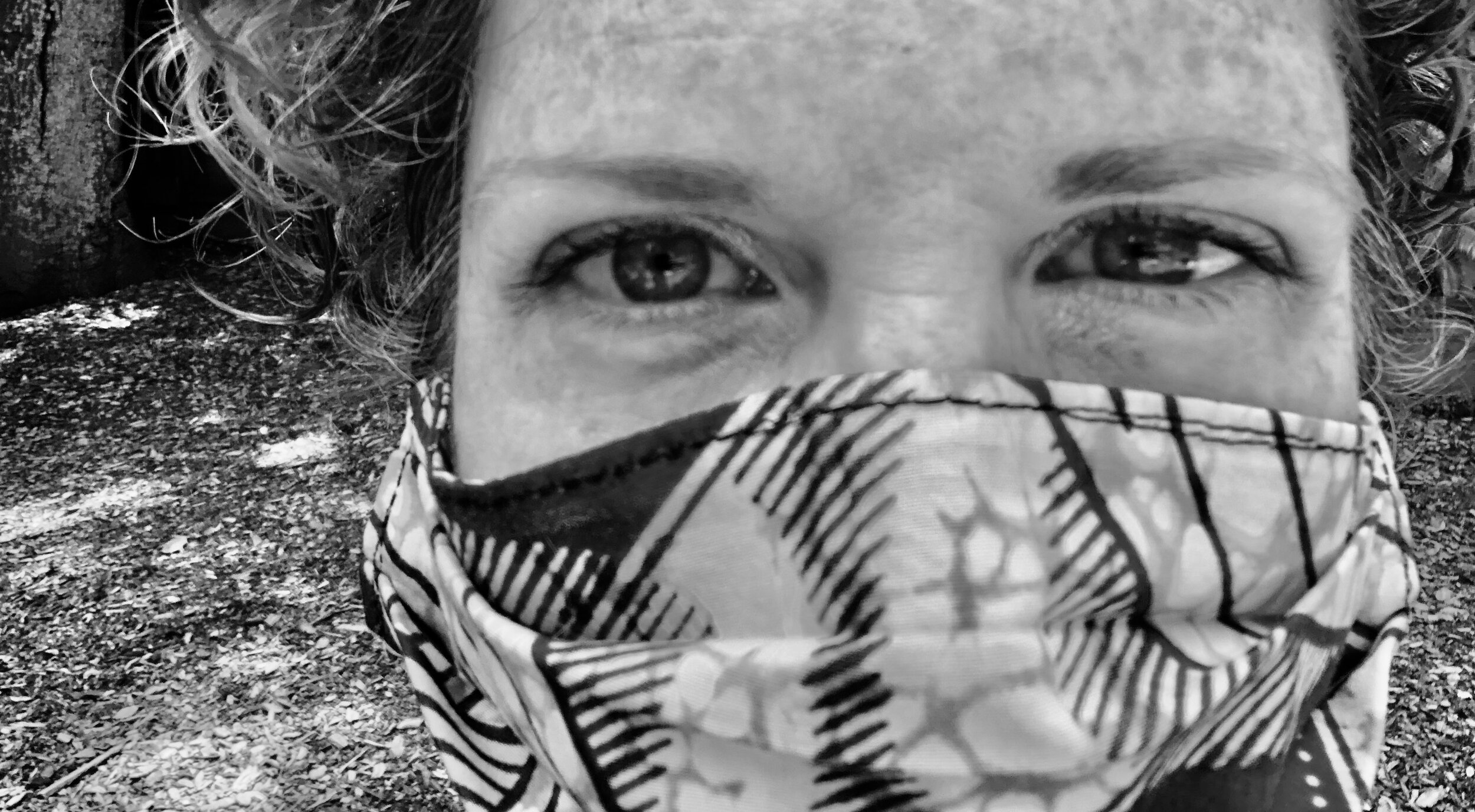
What I love about the masks


IMG_7050.jpeg
What I love about the masks
Is they are a visible indication
Of an internal decision to protect,
to guard,
to say your safety is more important
than my lipstick
or even my smile.

What I love about six feet apart
is that I see you
and I honor the space you may need
to remain whole,
to celebrate the next milestone,
to feel my reverence
at your very being.

What I love about staying home
is that your unvarnished face
has become more beautiful.
Your presence,
the never deserved,
but always welcomed
declaration of a Good creation.

May all of this distance
be a drawing near.
That I may guard your soul
as I guard the droplets flying from my mouth.
May this distance
create a sacred seat in my soul,
always awaiting your arrival.

Another child of Grace
seeking wholeness,
finding a little more peace,
knowing your blinding glory.

Jenny Warner • May 23, 2020

CONNECTING RITUAL:
Perhaps tonight before bed, whatever time that is in each of our homes, we and so join our souls with each other and the people of the whole earth:

God, here's what I hate about this time:
I hate... because I am longing for...
I hate.... because I am longing for...
I hate... because I am longing for...

Lord, have mercy.  Christ, have mercy on me.
Tend my soul in my sorrow.
Give me grace for myself in my grief.

God, it all comes back to love.
Even what I hate points me back to love,
by showing me what I care deeply about,
and reminding me of the gift of living.
My life is a gift.

So, God, here's what I love about this time:
I love.... because...
I love... because...

God, thank you.  Christ, keep my soul in your love.
Thank you, Lord.

Amen.

Wednesday, April 29, 2020

Relishing the Pleasure

Daily Devotion - April 29

I will send a brief message each day (except Mondays)
while we are pausing gathering in person.
- Kara


I like when things are easy to distinguish, clear, unambiguous. Especially my emotions.  This is not what I am getting these days.  How can I feel like things are more complicated and draining than ever, and ALSO simpler and easier?  How can I be both mourning and hopeful?  How can things seem both shocking and unreal, and also completely normal and ordinary?  
If I pick individual ingredients out of the stew of me, I am apparently, simultaneously, frustrated, energized, weary, grateful, sad, and content.  

What?!? 


In talking about what life has been like these past few weeks with my spiritual director today, I found myself sharing all sorts of joyful moments, moments of connection, and play, and rest, and fun.  They just kept bubbling up and out of me.  Then I said aloud, "Maybe I am afraid to talk about the hard stuff so I am just telling you all the good things?" And I sat and thought a minute, and no, these are what I wanted to share. Gratitude for these things is what I was genuinely feeling. She watched me do all this through the screen, and then she asked, "What does it feel like to relish the joy and delight?"


Good grief.  
Turns out it's WAY harder for me to "relish joy" than to wallow in despair.  When I try to receive the gifts I am being given in the midst of this, I can get very judgmental.  Here are some of the things I immediately say to myself (which, by the way, I would never say to - or even think about - someone else): 
 If I enjoy it, am I selfish? What about all those genuinely suffering? Not just the terrified sick and the exhausted frontline workers, but those without food, or job, or safety, or stability...  Can I feel happy in this when there are those whose suffering has been exacerbated tenfold by the societal change that has meant being trapped at home with someone abusive, or without the support of teachers and the two school meals a day, or with your own demons that roar up and take over when not carefully tended?  
What does it say about me if I let myself have fun right now? That I'm out of touch? That I am glad this happened?  That I don't miss what life was or want it to go back to "normal"?  That I don't wish I could look toward the future - I'm ok with this weird perpetual present? 

Turns out it's WAY easier for me to ignore and dismiss my pleasant, enjoyable emotions than my unpleasant, painful emotions. Huh.  


I've done a lot of work in my life making space for unpleasant emotions, recognizing the gift they bring and the importance of feeling them. But I haven't done as much work around the pleasurable, lighter emotions.  I've acted as though those don't matter as much. As though those don't provide just as much information, just as much depth, just as much capacity to teach, and change, and grow me as the darker, heavier feelings do.

Today she made me sit in the gratitude.
She said, "Make space for it to get as big as it wants to."
It got big. It wanted more space than my body could hold and it spilled out my eyes.

Evidently, amidst the loss, sorrow, worry, fatigue, empathy and anxiety about the future, I have also been feeling a surprising amount of joy and gratitude, for the gifts of insight, beauty, connection, contribution, mutuality, play, creativity and cooperation that keep popping their lovely heads up through the clouds each day.
I am going to work on tasting each emotion - and relishing the pleasurable ones.

Here is my (re)learning for today - (with a slightly different emphasis).

This being human is a guest house.
Every morning a new arrival.
joy, a depression, a meanness,
some momentary awareness comes
as an unexpected visitor.

Welcome and entertain them all!
Even if they are a crowd of sorrows,
who violently sweep your house
empty of its furniture,
still, treat each guest honorably.
They may be clearing you out
for some new delight.

The dark thought, the shame, the malice.
meet them at the door laughing and invite them in.
Be grateful for whatever comes.
because each has been sent
as a guide from beyond.


— Rumi, The Guest House

CONNECTING RITUAL:

There are three different options for this prayer exercise below.  One alone spoken, one alone writen, and one to do with others in your home.

Perhaps, today at dinner, or at the end of the day, whatever time that is in each of our homes, we might pray in this way, and so join our hearts:

GRATITUDE PRAYER
This prayer is a mind-wandering, free-association gratitude-fest.  No limits.
It can be a powerful experience alone – like taking an extra deep breath and feeling air in the way bottom of your lungs where you almost never let it reach.  It’s expanding and cleansing, and also rearranges your insides back to how they were meant to sit, and you’ll find you rest deeper and more authentically.
It’s a very different, but just a wonderful, experience, when done with kids.

Alone
You can do this in the silence of your heart or in spoken aloud words, but do it alone somewhere (even if that means sitting on the bathroom floor to get away from your family).  Inside, outside, walking, sitting, figure out what works for you this day; you could also do it in the dark, after you’ve laid down to sleep, and simply close however you wish.

Begin:
Thank you God, for…
And say the first thing that comes to mind, and then the next, and see where it takes you.  Whenever you reach a quiet heart, take a deep, cleansing breath in and blow it slowly out, and begin again.
After it feels complete, close with these words:

The blessings of heaven,
the blessings of earth,
the blessings both ordinary and sublime,
on those I love, this day,
and on every human family.
The gifts of heaven,
the gifts of earth,
the gifts both ordinary and sublime.
Amen.

Alone - written
This is a list-writer’s delight.  Simply begin by writing:
Thank you God, for…
And say the first thing that comes to mind, and then the next, and see where it takes you.  Whenever you reach quiet, take a deep, cleansing breath in and blow it slowly out, and begin again.

After it feels complete, Close with these words:
The blessings of heaven,
the blessings of earth,
the blessings both ordinary and sublime,
on those I love, this day,
and on every human family.
The gifts of heaven,
the gifts of earth,
the gifts both ordinary and sublime.
Amen.

With family
Tell those you gather with that you are going to do a thank you feast. You are going to start thanking God for something.  And then sharing every single thing that comes to mind, whether small or big, gets to be said aloud.  If it helps to go in a circle, feel free, otherwise, popcorn-style works.  Some families need a bit more structure, so it would help to say, “Each person gets a turn, so when you have something , you say,
Thank you God, for…"
And everyone responds, Thanks God!
And then it is the next person’s turn.
Keep taking turns thanking God for things.  Let yourself go beyond your comfort zone, ie, past where you feel like wrapping it up (or stopping the kids).  See if you can get all the way to a lull and see what might come next.
When things wind down and seem to be ending, close with these words:
The blessings of heaven,
the blessings of earth,
the blessings both ordinary and sublime,
on those we love, this day,
and on every human family.
The gifts of heaven,
the gifts of earth,
the gifts both ordinary and sublime.
Amen.

 (closing blessing adapted from J Philip Newell)

Friday, April 24, 2020

Starting close in

Daily Devotion - April 24

I will send a brief message each day (except Mondays)
while we are pausing gathering in person.
- Kara


This poem is speaking to me this week:

“Start Close In”
by David Whyte

Start close in,
 
don't take the second step

or the third,

start with the first

thing

close in,

the step you don't want to take.
Start with
the ground
you know,
the pale ground
beneath your feet,
your own
way of starting
the conversation.
Start with your own
question,
give up on other
people's questions,
don't let them
smother something
simple.
To find
another's voice
follow
your own voice,
wait until
that voice
becomes a
private ear
listening
to another.
Start right now
take a small step
you can call your own
don't follow
someone else's
heroics, be humble
and focused,
start close in,
don't mistake
that other
for your own.
Start close in,

don't take the second step

or the third,

start with the first

thing

close in,

the step you don't want to take.

Close in for me today has looked like realizing the big project won't get done by the deadline, that life right now is a series of interruptions, and tending those interruptions is as important as the thing I thought was the the thing

It has looked like more waves of tears and heartbreak, cancellations and questions, goodbyes thwarted and closure averted, and the phrase, "Yes, this is really hard," as the mantra that doesn't ever seem to not be the only right thing to say.

It has looked like a car ride with the dog ears and kid ponytail flapping in the wind, giant grins flashing at the sun.

It's been a raucous carwash - have I ever really watched each part? - and the joy of watching the girl watching the dog watching the suds.

It has been a phone call with my Grandma, who got the Postem I sent, remembering her stories of drinking it during the war, and hearing about my uncle's coming to terms with ending treatment and accepting death, and how she wishes she could go down to Georgia and get her hair done.

It has looked like the creep of exhaustion, and the deliberate and not easy choice toward nourishing food, and the spirit-lifting meeting of a stranger who sewed us handmade masks - washed, dried, scented with essential oils and sealed in plastic.  

And the day is only half over. 

I know no other way right now, than to start close in.
Close in is all we have.
The choices we have right in front of us - not the ones way out there, in the future, not the ones other people are making or not making.
Just this. Just now. Starting close in.

CONNECTING RITUAL:

Perhaps, tonight before we go to bed, whatever time that is in each of our homes, we might pause, reflect, and pray in this way, and so join our hearts:

A litany of recognition...

It can feel like all our control is gone. We used to have so many choices, and we took them for granted.  Now we are limited.  But still - we make choices, all day.

Why not reflect for a minute on the choices you made today?

Some you're proud of; some you regret.  This is not about judging between good and bad choices; it's about receiving the gift of having choices and making choices.

Eg., Today I chose to eat ___ for breakfast... 
Today I chose to/not to shower...
Today I chose to look at/read/watch this...
Today I chose to listen to my body's need for rest...
Today I chose to numb myself to the barrage of feelings...
Today I chose to turn my face to the sun... etc.

Closing prayer: 

Thank you, God, for the gift of life. 
Thank you God for this life.
Thank you for my life.

Thank you, God, for this day.
Thank you for the gift of this day.

Amen.

Tuesday, April 7, 2020

Ending this day restored

Daily Devotion - April 7

I will send a brief message each day (except Monday) while we are pausing gathering in person.
- Kara


It's been a full day for me and my household - at one point 3/4 of the residents in my house were on different zoom calls. There was simply more to do than time for, and it's hard to stay grounded when that's the case. But the sun is bright, and the air is warm, and each day is its own day, with gifts and fears, disappointments and satisfaction all mixed in. 

The Psalms are a gift to us right now - prayers that run the gamut of emotions.  
This one spoke to me today.

Psalm 54 
Awaken me, O Blessed Healer with
your holy mercy,
that I may be free of fear.

Hear my prayer, O Holy One;
give ear to the words of 
my mouth.

For nagging doubts assail me,
bringing loneliness and pain;
I remember not the Beloved, so
overwhelming are my fears.

Yet behold, You are my helper,
the upholder of my life.
With You I have the strength to
face my fears;
Your faithfulness will help me 
transform them into love.

With boundless confidence, I
abandon myself into your Heart;
I give praise to your holy Name,
O Beloved,
with gratitude and joy.
For You deliver me from my illusions,
and, through Love, my heart
opens to Wisdom.

from Psalms for Praying, by Nan C. Merrill


CONNECTING RITUAL:

Perhaps, tonight before we go to bed, whatever time that is in each of our homes, we might pray this prayer, and so join our hearts:
I seek your presence, O God,
not because I have managed to see clearly
or been true in all things this day,
not because I have succeeded in loving
or in reverencing those around me,
but because I want to see with clarity
because I long to be true
and desire to love as I have been loved.
Renew my inner sight,
make fresh my longings to be true
and grant me the grace of loving this night
that I may end this day restored to my deepest yearnings,
that I may end this day as I intend to live tomorrow,
as I intend to live tomorrow.
Amen.
 

Sunday, December 1, 2019

Sharing with God

Hannah, a window designed by Watkins Stained Glass  


Hannah

Ask anyone who has ever wanted a child and struggled to conceive, whose gone through the agony of multiple miscarriages, the terrible roller coaster of invitro, or the long and scary process of adoption, ask them what it is like to finally, after everything, hold their child in their arms.  There is nothing like it. It is miraculous.

My friend adopted her daughter from Haiti, from an orphanage where she volunteered.  In this place, where there were too few sets of arms, and too many babies needing holding, once or twice a year, my friend would go  down and hold babies.  After fostering locally, and praying and longing for a long time, and after many arduous legal steps, she flew to Haiti, back to that orphanage, to meet the baby girl that was to be hers.

She texted me a photo that day, the tiny soft face of a two month old, pressed against her own tear-streaked and joy-filled one.  She held her in her arms and whispered that she loved her and that she couldn’t wait to be her mom. And then she had to return home. She had to leave her baby alone in the crib where she would not likely be held much, for the next few weeks, to await the final legal hurdles.  

But in the meantime, a bureaucratic move in Haiti closed adoptions, and for the next fourteen months her daughter remained in the orphanage while her case stalled on hold.  She visited twice in that time, for a few desperate days and nights she sat in a rocker in a concrete room surrounded by metal cribs, holding her baby in her arms, talking to her and singing to her, and then laying her down and leaving, getting on a plane and flying home without her. 

Finally, the paperwork cleared, and she flew back and was able to take her home, when she was a year and a half old.  Finally my friend became Stefanie’s mother.  And Stefanie is hers to raise, forever.  For months afterwards, she wore Stefanie in a pack, to give her human contact and help her bond.  She watched her sleep and prayed for her in the dark, an astonished thank you to God as she listened to her peacefully breathing. 

Imagine if, after all that, one day my friend packed a suitcase, and buckled Stefanie into a car seat, drove across the state to a church, took her out of the car and held her hand up to the door, pulled it open and walked inside, placed the suitcase beside her and knelt down, brushed Stefanie’s braids from her face, kissed her forehead, handed over paperwork terminating her parental rights to whomever was standing there, and turned and walked away?  

How could she do it? 
How can Hannah give back her child? And how can God allow it? 
How can we accept this story? How can this be in our bible? 

I remember this story from Sunday school. It didn’t go like that. It was about how badly Hannah wanted a child, and how she was made fun of for not having one, and how she prayed really hard and didn’t care how she looked doing it, and how God heard her prayer and gave her a child, and how she was so thankful she gave him back, and how cool it was that Samuel got to live in the temple, lucky him!, and how awesome God is for answering prayer, and how selfless and obedient Hannah is for saying Thank you so big.  

We never questioned the darkness in this story.  Surely we glossed over the terribleness of letting go of your child, the child you’ve wanted so badly.  And we didn’t talk about what it means to be barren, which is to say, in Sunday school we may have had this unfortunate term explained awkwardly as being unable to conceive, but really, we didn’t discuss the barrenness of the human condition, the wilderness of a desolate soul, empty, isolated, defined by longing, every moment unfulfilled, utterly despairing.  And we surely didn’t talk about sacrifice.  Deep, terrible sacrifice.  Or question who God was who could let such a thing happen.

Hannah’s song, that we chanted earlier, her prayer, is famous.  It harkens back to the song of Miriam when the people are delivered out of slavery in Egypt, and it foreshadows the song of Mary when the fetus John leaps in Aunt Elizabeth’s womb at the sound of the voice of the mother of the God.  Hannah is known for this song.  
And who wouldn’t sing a song of victory and vindication, a song of awe at God’s amazing, table-turning ways that lift up the poor and bring down the mighty – when you go from being desperate and hopeless to being given the very thing your heart most desires! That is something to sing about!

But her song doesn’t come when her prayers are answered; they are not about finally getting the child she has always wanted and being his mother for the rest of his life. Hannah sings when she leaves her son at the temple, when she gives the child back to God.  
When she turns and walks away from the one thing she most desired in the whole world, she does it with a song of praise.

There is something going on here that feels nearly impossible to grasp.  As we begin to ask our questions, “Who is God and what is God up to?” And “What is a good life and how do we live it?” specifically in the lives of people we are journeying with, right out of the gate we come up against a problem with Hannah.  Because our view, my view, of a good life, would be for her prayer to be answered and for her finally to be Samuel’s mother, and for Samuel to be hers to raise, forever. And God would be the one who answers that prayer, lets that fulfillment happen, doesn’t take back the gift God has given. 

But that’s not how Hannah sees it.  She names her son Samuel, a play on the verb sa-el- to ask- because she had asked him of the Lord. But this verb means both movements, both to ask fervently, and to lend back. The movements of giving and receiving, receiving and giving back. The gift of it all. So that Samuel’s very identity is one who is received and given back, the gift, in whom is experienced the movement of God toward us, and us in return to God.

For us, the good life is wanting something really badly and then getting it. The world’s stories are happily ever after endings. Rags to riches, humiliated to vindicated, worthless to important. Hannah’s identity changes in the world, she becomes Samuel’s mother. She is no longer the barren one, her own persistence means God heard her and answered her prayers. The story should stop there. The moral could be, don’t give up on your dreams. We’d love that kind of story. They make movies about those stories.  They write Sunday school books about those stories.  

But that’s not a way of God story.  Right in the middle between the creation and the eschaton, between the exodus and the promised land, between palm Sunday and Easter, is the part we skip over or race through or whitewash when we tell God’s story because it gets too messy, because we don’t know how to explain it.  We make it all cheery and shallow instead of painful and disconcerting, cute jewelry crosses instead of gut-wrenching “My God, my God why have you forsaken me?” because the Christian life is supposed to be all victory and joy, and so we don’t talk very much about either the barrenness or the sacrifice, we don’t talk about the unanswered prayers or the terror of answered prayers and what they demand of us. 

Hannah has been drawn into something so miraculous that she envisions something so far beyond what we modern people are satisfied with.  She has changed. She’s no longer barren, written off, hopeless, but neither is she just Samuel’s mother.  She has been drawn into a bigger reality, and she wants nothing less than that for her own child.  What has happened can only be from the act of God, and so she will only let this baby participate in the act of God. Nothing less will satisfy.

So, as she leaves her child there, Hannah sings.  She sings a song of victory, and hope, and joy. She praises a God of strength and might, and thanks a God of power. 
She pronounces God’s preference for the weak, God’s deliverance of the poor, God’s partiality for the barren, the lost, in the story of salvation.
She speaks against the proud and the arrogant, those who think they have it all.  She declares God’s lordship over all the earth.  She sings this with all her heart.

The story doesn’t stop there, because God’s story never does.  
In a very turbulent time for Israel, the people kept on asking God for a King, a human leader other than God, that they could turn to, so they could be like the other nations. And finally God relents. But God needs someone to guide them in this time, to lead them to this king, and to advise the king too. God needs someone to be the one who goes between God and the people. And it will take a special person, one who will see the bigger picture, who will not seek to simply be king himself.  It will require one who looks beyond personal fulfillment to the greater cosmic story, and chooses to participate, chooses to trust God with his very life.  This is Hannah’s son.

Hannah’s story begins another story, Samuel’s story, and Israel’s story, actually, because the whole book of Samuel is really the story of Israel, Israel who was lost, and written off, hopeless and futureless.  This barren woman becomes God’s bearer of a lost nation’s future, a symbol of hope. 

His whole life long Samuel is to the people the embodiment of justice and compassion, he represents the ear of God and the voice of God.  He belongs to God and he belongs to Israel. He is the embodiment of the relationship of receiving and giving, God to the people, the people to God, the giving and receiving that it the gift of life when you live as those belonging to God.

We see Hannah again later in Samuel’s story.  It says in chapter two that every year when they return for the sacrifice at Shiloh Hannah brings Samuel a little robe that she has made for him.  And every year the priest acknowledges and honors her for her sacrifice.  And she and her husband go on to have five more children.  And the boy Samuel grows up before the Lord, claimed and cared for by God.  And years later Hannah’s song is taken up by King David and woven into his own poetry, into our Psalms, our scripture, after her son Samuel grows up and becomes a prophet of God who anoints a shepherd boy to be King, the ancestor of the Messiah.

Life is for sharing with God.  Even when what we most want is deeply good, the good life is not getting what we most want. 
And to live a good life is not to be passive recipients of God’s blessings. 

The good life is being a full participant with God in blessing the whole world.  
Hannah does not sing because she finally gets what she most wants.  She sings because she gives the gift back to God.  Because she is in the position of being able to give to God.  But her sharing began in the darkness, not just in the light. Not just when she has something to share but before that, when she was empty.  Hannah made her grief God’s business. She invites God into her barrenness. 
And when she does that, God takes her at her word and holds her to her promise, what dignity there is in that!  God receives Hannah’s impossible gift, but not as a passive recipient either.  God participates in Hannah’s gift by making Samuel a blessing to the nation, a linchpin in salvation history. Hannah trusted God and shared her anguish, and God trusted Hannah and used her help redeem God’s people.

Hannah becomes a prophet, singing out with joy about the end of the story that awaits us all, because she herselfhas tasted the hope, the fullness and freedom, the blessing of a God who doesn’t play by the rules of the world. She’s released from competition and inadequacy, of an identity defined by what she can or can’t produce, and even of a good life horizon that ends with our own personal fulfillment and joy. Instead she has found her life taken up into the life and purpose of God.   The movements of giving and receiving, receiving and giving back. The gift of it all. Hannah sings because she has tasted the real reality.

Life is a gift.  All of it.  The light and the darkness of it.  We are neither in this desolate, alone and against, nor are we called to be passive recipients.  We are invited to be full participants, collaborators with the Divine. 
But to do so, we must go to our own barren places of longing and despair and refuse to sit in them alone. We must invite God into our suffering, tell God what we are experiencing, and demand God’s response. 
When we do, we will find that the places of death, and darkness, and discomfort that we’d rather skip past, that we’d rather make into shallow moral lessons, those are where the story really happens, where the end is glimpsed, and the beginnings are created, and the redemption is worked out, and people are made real, and life is deep and significant, and we touch the eternal.  

And the beloved ones we are given, and given to, on loan from God, in this short and miraculous life, are also participants in the real.  Our identity is as those who are received and given back; we are gift to one another, in whom we experience the movement of God toward us, and us in return to God.  And we can give one another to God.  We can pray nothing less than the life and purposes of God for one another, and accept nothing short of full participation in the cosmic blessing of the world for ourselves.  And God will receive and honor that gift.  Because God comes and give us God’s very self.  
This is how we enter Advent. Come, Lord Jesus.

Amen.

This is part of a series, journeying with some of our Biblical ancestors: HannahMaryAnna & SimeonJohnSamuelDavid*, The Samaritan Woman

(*This is an older message about David, in this series, we had a wonderful performance of 'David" by Theater for the Thirsty)
Therefore...

    Romans 12:1-8 When I was ten years old at summer camp, we could earn points for various activities. My favorites were archery, target sh...