Yesterday morning, a couple blocks from my house, a neighborhood dad of two stepped outside his front door to confront a person trying to get into his car. He was shot dead in his own front yard. His sons began the day with a dad and ended it without one.
There is a fragility to life that we mostly forget about, else how would we go anywhere or do anything at all? How would we send our kids off to camp, or school, for that matter? How would we go to the doctor’s office, or the grocery store, or the mall, or pick up our siblings from a friend’s house? How would we eat anything or drink anything or get into any kind of vehicle? Life is risky and scary and bad things happen, and even when they don’t, just being alive is a guarantee of death.
So when we come to a story like this one, where a miracle is interrupted with a miracle, where Jesus heals a woman who has suffered for years, and brings a dead child back to life, what are we meant to take from it?
This week a young person in the congregation and I had a wonderful theological conversation about how, often, the bible is used like some kind of weird unambiguous how-to book. Or maybe we tell these stories like they’re a superhero movie: look at the Amazing Jesus’ awesome powers! Or maybe we read them like they’re trying to get us to think a certain thing, or believe a certain thing, and if we do that, somehow we will be deemed a good person, or we will crack the formula for escaping suffering or death like these people did, (though, spoiler, eventually they died too). We also talked about how strange and hard it is to even try to understand something written in an entirely different culture, language and part of the world, thousands of years ago, to pre-modern people, about a way of life we can only begin to imagine.
So, to guide us, let’s step back and remember the question that is never not helpful when approaching scripture : Who is this God, and what is God up to here?
The story begins with Jesus returning from somewhere. If we looked just before this, we would see that he was across the sea of Galilee in Gentile country, where he had just cast demons out of a man who had been afflicted since he was young and sent them into a herd of pigs who ran over a cliff to their death. Dramatic stuff. Also, eyebrow-raising on multiple fronts. As a good Jewish teacher, what was he doing with Gentiles? Who did he think he was addressing demons? What was he doing around pigs, for that matter? A cesspool of impurity, all of it, if you’re keeping track of that sort of thing.
So, he returns and the crowds press in on him, hundreds of people cramming in around him- eager for more of this holy man’s intriguing teaching and marvelous works. And then comes the temple leader, Jairus, whose own beloved child lay sick and dying. Perhaps the crowd parts to let him through because of his status. And they watch as he begs Jesus to come heal his daughter, and Jesus heads toward his house. But the journey is interrupted by a woman who for twelve years has been bleeding.
Every culture has purity taboos. We, for example, would never invite people over to eat dinner on our bathroom floors. Purity rules in ancient Judaism were not about sin, they were about proximity to either life, as God intended it in Eden, or to death and decay. What is dying or showing signs of decay is not to be in the presence of the Creator and sustainer of life. So there were laws around what was pure and what was impure and how to restore purity to something, to bring it from an impure, deathly state back to a clean state of life. By practicing purity laws, the Israelites were always conscious of life and death, aware of their own morality.
A woman’s period then – while inside her is a life-giving force. But when the life-force is leaving her body it becomes a symbol of death. While she is unclean she is to separate herself and not to be touched for seven days, then, after a ritual bath she resumes normal life. If someone touches her, they too become impure or unclean until the end of day.
Now we meet a woman who has been bleeding – without end- for twelve years. Besides the fear and worry medically, spending everything she had on doctors and getting no help, the constant physical discomfort and exhaustion is all compounded by the isolation, and the understanding that she is closer to death than life. Not just for seven days, but every day for twelve years. She is separated, her sense of belonging must feel permanently severed, her purpose and place in this life shut down. There is no way for her to become pure again, no way out of the death-stamped existence. It’s like she living in Sheol – the underbelly of the earth, where they believed dead souls floated around aimlessly contributing nothing.
So when she gets close enough to Jesus to touch his cloak, saying to herself, if I can only just touch the very edge of his garment, I will be healed, she is also protecting him from her uncleanness. And though she just brushes against the hem of his clothing, Jesus asks who has touched him.
His disciples are incredulous, “What do you mean who touched me? You’re pressed in on every side by people!” But Jesus has been touched; someone’s personhood has reached out in longing and trust from the grip of death toward the source of life, and he has responded with healing, even before he knew what was happening.
And then, the scripture says, “When the woman saw that she could not remain hidden…” For twelve years she has been hidden, hiding, outcast, and she sought to sneak a miracle, to secretly skulk her way back to life. But she will not remain hidden; in this moment she will be seen. When Jesus asks who it was that received his healing power she comes forward and trembling, she tells everyone what she has suffered, and what has just happened to her. Jesus praises her faith, and declares in front of everyone, that she has been made well. Go in peace. And with his words, he welcomes her back to the act of living.
Then the interruption is interrupted again by messengers from the Jairus’ house, letting him know it’s too late; his daughter has died. Don’t waste any more of the teacher’s time. But Jesus responds with the repeated refrain of messengers of God throughout scripture, the most used phrase in all of scripture – Don’t be afraid. Then, only believe and she will be saved. But what were they to make of that? It’s over. We know what the final period is on the end of all our sentences; it’s death. Death is the winner. And death has struck here. So what could he possibly mean that she will be saved? And what is there to believe at this point?
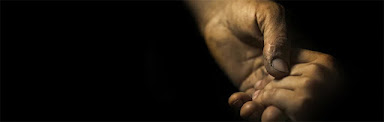
When Jesus arrives, he sends away all the mourners and brings just Peter, James and John and the girl’s parents into the room and closes the door. Then he reaches out his hand and grasps onto the child’s hand.
There is nothing more impure, unclean, than a dead body. Proximity to a dead person is as close to death as you can get, unless, of course, you yourself are the dead person. If you were even under the same roof, you were unclean. If you touched a dead body, you were unclean for seven days, and would need to separate yourself from others, and then after a ritual bath you could resume normal life.
Jesus reaches out and touches the hand of the dead child. And at his touch, her spirit returns to her. She is restored to the living, brought back into life, given back to those to whom she belonged. And Jesus tells them to give her something to eat – to feed her body and spirit with care and nourishment, to welcome her again to the act of living.
Here is what all these stories in a row tell me today about who God is and what God is doing: There is nowhere Jesus will not go, no boundary he does not cross, to restore people’s humanity, to claim into God’s belonging and love every single person. Gentiles? Demons? Pigs? Impurities of every kind? Not even the final fearful boundary, death itself, stops the embodied love of God from touching us and being touched by us. Our human divisions and rules? Our mighty attempts to do it all right and be worthy and good? When they get in the way of our belonging to God and each other, the one who made it all comes into it all and tears down those walls, crosses enemy lines right into death’s hostile territory, because no power is greater than the love of God, and no claim on us is more authoritative or final than God’s claim that, no matter what and always, we are a beloved child of God.
I have sorrow over neighbors who woke up today, if they slept at all, steeped in suffering for the senseless loss of their dad yesterday. And if I were to read this story and think that somehow I am supposed to think that trusting Jesus means terrible things don’t happen to us, I would be delusional. Life is filled with suffering. And death will come for us all. And every one of us, from time to time, find ourselves living closer to death than life. And there is no shame in our mourning – for lost dreams and lost lives, for the loss of things that will never be, and the loss of things that we thought made us who we are, and the senselessness of violence and the fragility of being human.
But there is a greater story that holds us all: this world, and everyone in it, belongs to God. And when healing happens through the touch of the embodied God-with-us, in these stories and in our own lives, it reveals that the perimeters we think are impermeable are not the final word.
And we have a place too in these stories, to go where Jesus is and join him there. To go to the places of death and sorrow, the places where belonging seems severed, and purpose is shut down. We will not allow shame, or fear, or judgment, keep people hidden. We will see each other and recognize healing and extend peace, and feed bodies and spirits with care and nourishment, and welcome one another, again and always, to the act of living. Because our dead and risen Savior is bringing all things – especially in death – toward life. And I, for one, want to be in the room when it happens.
Amen.


